GATE 2023 CE (CE2) – Question 62
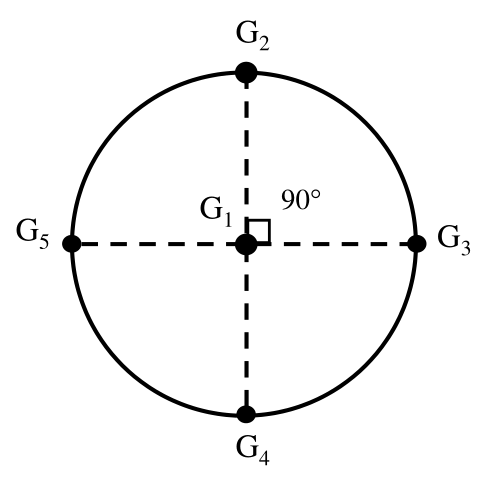
A catchment may be idealized as a circle of radius 30 km. There are five rain gauges, one at the center of the catchment and four on the boundary (equi-spaced), as shown in the figure (not to scale). The annual rainfall recorded at these gauges in a particular year are given below.
| Gauge | G1 | G2 | G3 | G4 | G5 |
|---|---|---|---|---|---|
| Rainfall (mm) | 910 | 930 | 925 | 895 | 905 |
Using the Thiessen polygon method, what is the average rainfall (in mm, rounded off to two decimal places) over the catchment in that year?
Practise this question in The GATE Grind →
Show answer and explanation
Correct answer: 908.00 to 917.12
Explanation
**Step 1: Thiessen areas.** The catchment is a circle of radius 30 km with gauge G1 at the centre and G2 to G5 on the boundary (north, east, south and west).
- The perpendicular bisector between the centre and each boundary gauge lies 15 km from the centre. These four lines bound the central polygon, a **square of side 30 km**: area $A_1=30\times30=900$ km².
- The total catchment area is $\pi(30)^2=2827.4$ km². The remaining area is shared equally by the four boundary gauges:
$$A_2=A_3=A_4=A_5=\frac{2827.4-900}{4}=481.9\text{ km}^2 .$$
**Step 2: weighted average.**
$$\bar P=\frac{910(900)+(930+925+895+905)(481.9)}{2827.4}$$
$$\bar P=\frac{819\,000+3655\times481.9}{2827.4}=\frac{819\,000+1\,761\,300}{2827.4}\approx\mathbf{912.56\ mm}.$$