GATE 2023 CE (CE2) – Question 65
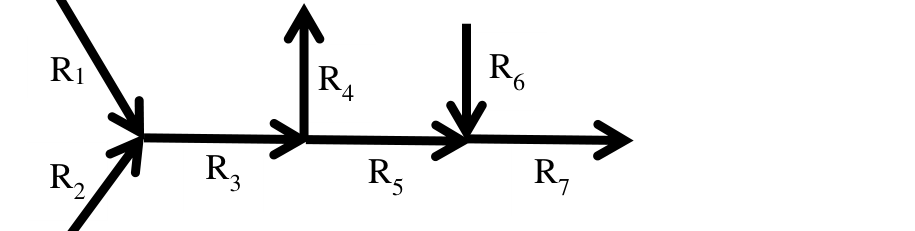
A system of seven river segments is shown in the schematic diagram. The $R_i$’s, $Q_i$’s, and $C_i$’s (i = 1 to 7) are the river segments, their corresponding flow rates, and concentrations of a conservative pollutant, respectively. Assume complete mixing at the intersections, no additional water loss or gain in the system, and steady state condition. Given: $Q_1=5$ m$^3$/s; $Q_2=15$ m$^3$/s; $Q_4=3$ m$^3$/s; $Q_6=8$ m$^3$/s; $C_1=8$ kg/m$^3$; $C_2=12$ kg/m$^3$; $C_6=10$ kg/m$^3$. What is the steady state concentration (in kg/m$^3$, rounded off to two decimal place) of the pollutant in the river segment 7?
Practise this question in The GATE Grind →
Show answer and explanation
Correct answer: 10.63 to 10.73
Explanation
This is a steady-state mass balance with complete mixing at each junction. The pollutant is conservative, so the pollutant load ($Q\times C$) is conserved.
**Step 1: junction of R1 and R2 forming R3.**
$$Q_3=Q_1+Q_2=5+15=20\text{ m}^3/\text{s},\qquad C_3=\frac{5(8)+15(12)}{20}=\frac{220}{20}=11\text{ kg/m}^3 .$$
**Step 2: branch R4 leaves R3.** Taking water off in a branch does not change the concentration of what remains:
$$Q_5=Q_3-Q_4=20-3=17\text{ m}^3/\text{s},\qquad C_5=C_3=11\text{ kg/m}^3 .$$
**Step 3: R5 joins R6 to form R7.**
$$Q_7=17+8=25\text{ m}^3/\text{s}$$
$$C_7=\frac{17(11)+8(10)}{25}=\frac{187+80}{25}=\frac{267}{25}=\mathbf{10.68\ kg/m^3}.$$