GATE 2024 CY – Question 16
The major product in the given reaction sequence is Q. The mass spectrum of Q shows ([M] = molecular ion peak)
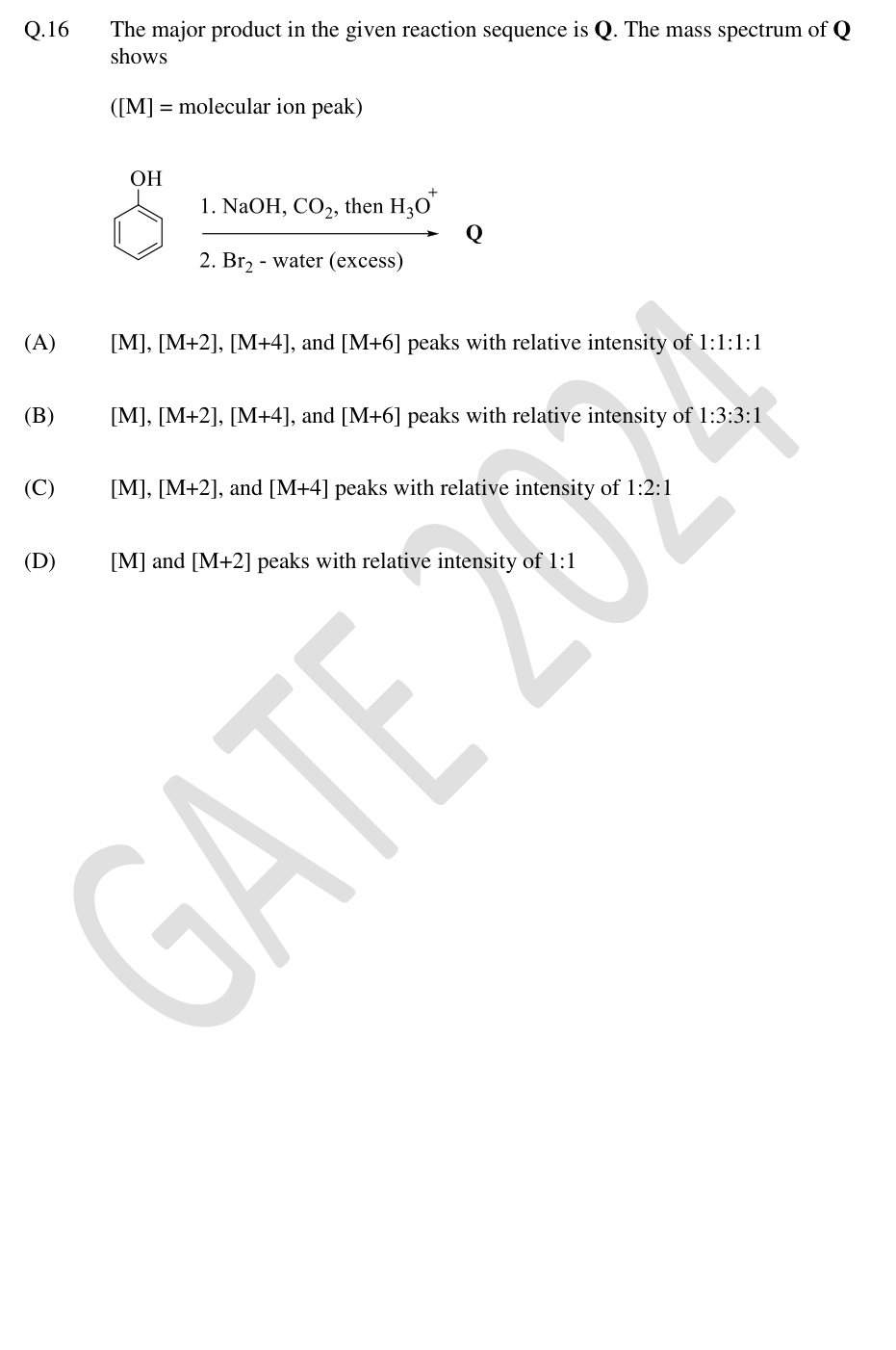
Practise this question in The GATE Grind →
Show answer and explanation
Correct answer: (B) [M], [M+2], [M+4], and [M+6] peaks with relative intensity of 1:3:3:1
Explanation
**Step 1: Kolbe-Schmitt reaction.** Phenol with NaOH gives sodium phenoxide, which reacts with $CO_2$ (and is then acidified) to give **salicylic acid** (2-hydroxybenzoic acid).
**Step 2: excess bromine water.** Phenols are strongly activated. With excess $Br_2$/water the ring is brominated at the three activated positions (the two ortho and the para positions), and the carboxylic acid group is lost as $CO_2$ (bromodecarboxylation). The product Q is **2,4,6-tribromophenol**.
**Step 3: mass spectrum.** Bromine has two isotopes of almost equal abundance, $^{79}Br$ and $^{81}Br$ (about 1:1). For a molecule with three Br atoms the pattern is given by the expansion of $(1+1)^3=1+3+3+1$:
| Peak | Br isotopes | Relative intensity |
|---|---|---|
| M | three $^{79}$Br | 1 |
| M+2 | two $^{79}$Br, one $^{81}$Br | 3 |
| M+4 | one $^{79}$Br, two $^{81}$Br | 3 |
| M+6 | three $^{81}$Br | 1 |
The pattern is **M, M+2, M+4, M+6 with relative intensity 1:3:3:1** (option B).