Home › Previous year questions › GATE 2024 CY › Question 43GATE 2024 CY – Question 43 Organic Chemistry · Organic Synthesis: Synthesis, reactions, mechanisms and selectivity involving the following classes of compounds – alkenes, alkynes, arenes, alcohols, phenols, aldehydes, ketones, carboxylic acids, esters, nitriles, halides, nitro compounds, amines and amides. Uses of Mg, Li, Cu, B, Zn, P, S, Sn and Si based reagents in organic synthesis. Carbon-carbon bond formation through coupling reactions – Heck, Suzuki, Stille, Sonogashira, Negishi, Kumada, Hiyama, Tsuji-Trost reactions; olefin metathesis, McMurry coupling and Buchwald-Hartwig amination reactions. Baylis-Hillman, Henry, Ritter, Sakurai, Tebbe olefination, Pauson-Khand and Nazarov cyclization reactions. Concepts of multistep synthesis – retrosynthetic analysis, strategic disconnections, synthons and synthetic equivalents. Atom economy and green chemistry, Umpolung reactivity – formyl and acyl anion equivalents. Selectivity in organic synthesis – chemo-, regio- and stereoselectivity. Protection and deprotection of functional groups. Concepts of asymmetric synthesis – resolution (including enzymatic), desymmetrization and use of chiral auxiliaries, organocatalysis. Carbon-carbon and carbonheteroatom bond forming reactions through enolates (including boron enolates), enamines and silyl enol ethers. Stereoselective addition to C=O groups (Cram, Prelog and Felkin-Anh models). Asymmetric aldol reactions – Evans reaction and proline catalyzed reaction. · 2 marks · Multiple choice
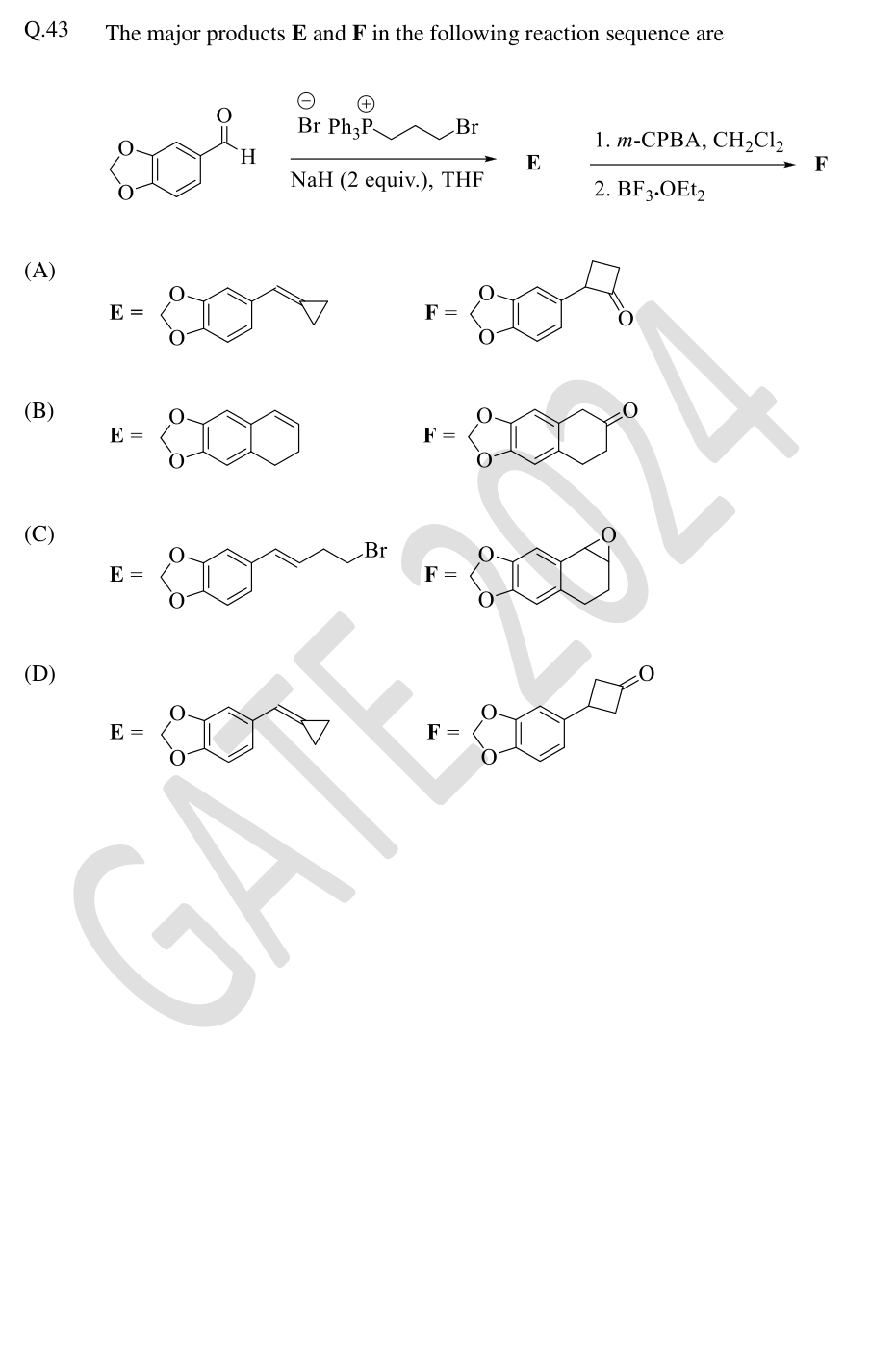
The major products E and F in the following reaction sequence are
Option A in the figure Option B in the figure Option C in the figure Option D in the figure Practise this question in The GATE Grind →
Show answer and explanation Correct answer: (A) Option A in the figure
Explanation The doubly deprotonated phosphonium reagent cyclizes during Wittig olefination to give the cyclopropyl alkene E. Epoxidation followed by Lewis-acid-induced cyclopropyl rearrangement expands the three-membered ring to cyclobutanone F.
Official GATE 2024 answer key: https://gate2026.iitg.ac.in/doc/download/2024/CYFinalAnswerKey.pdf