GATE 2026 CY – Question 20
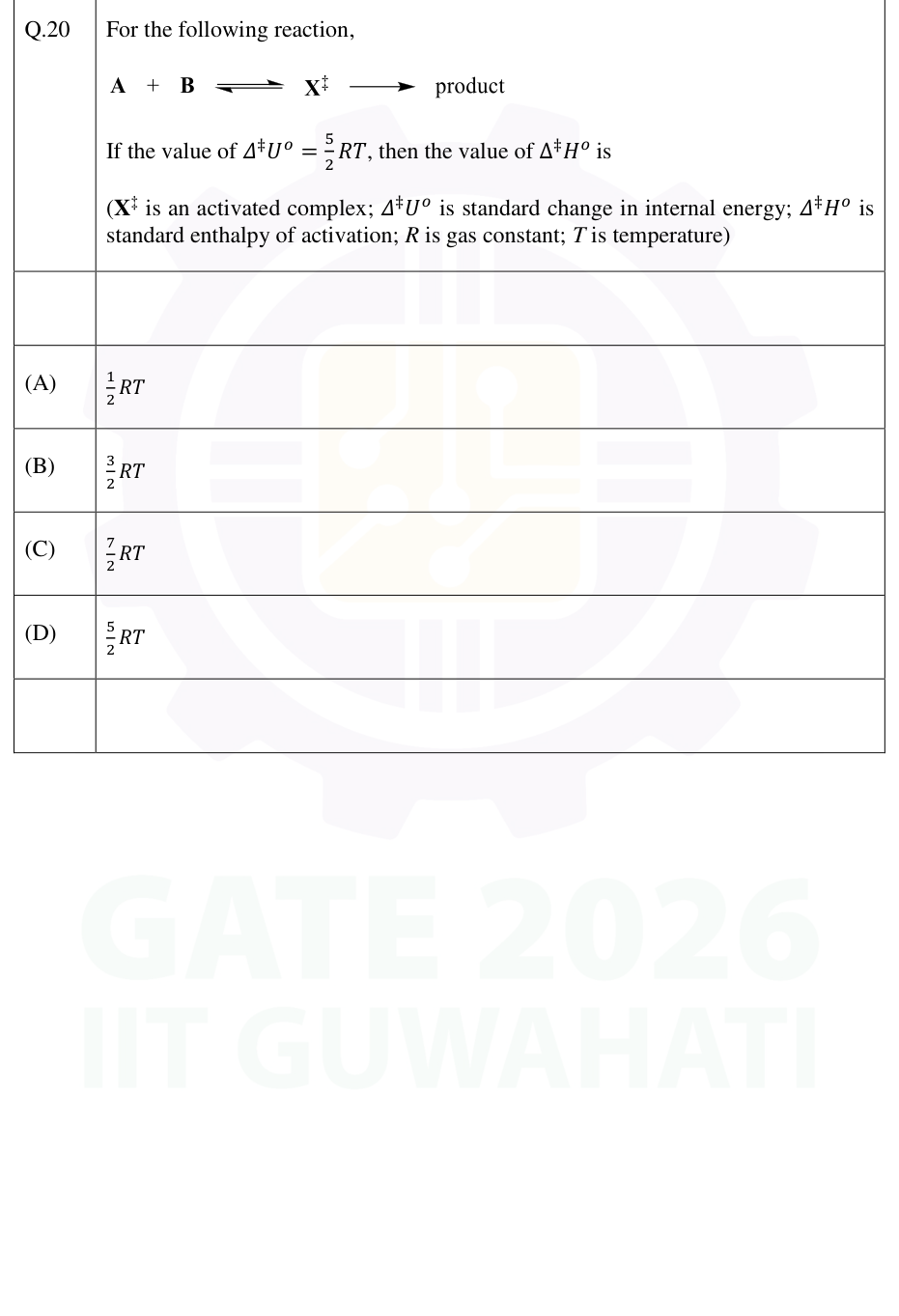
For the reaction shown, if $\Delta^{\ddagger}U^\circ=5RT/2$, the value of $\Delta^{\ddagger}H^\circ$ is (X‡ is activated complex; the two deltas are standard activation internal energy and enthalpy; R is gas constant and T temperature)
Practise this question in The GATE Grind →
Show answer and explanation
Correct answer: (B) $3RT/2$
Explanation
Relate the standard activation enthalpy and internal energy:
$$\Delta^\ddagger H^\circ=\Delta^\ddagger U^\circ+\Delta(PV)^\ddagger=\Delta^\ddagger U^\circ+\Delta n^\ddagger RT,$$
where $\Delta n^\ddagger$ is the change in the number of moles of gas on forming the activated complex.
**Here** two gaseous molecules A and B combine to give one activated complex $X^\ddagger$:
$$\Delta n^\ddagger=1-2=-1 .$$
**Numbers.**
$$\Delta^\ddagger H^\circ=\frac{5RT}{2}-RT=\frac{3RT}{2}\quad(\text{option B}).$$