GATE 2026 CY – Question 37
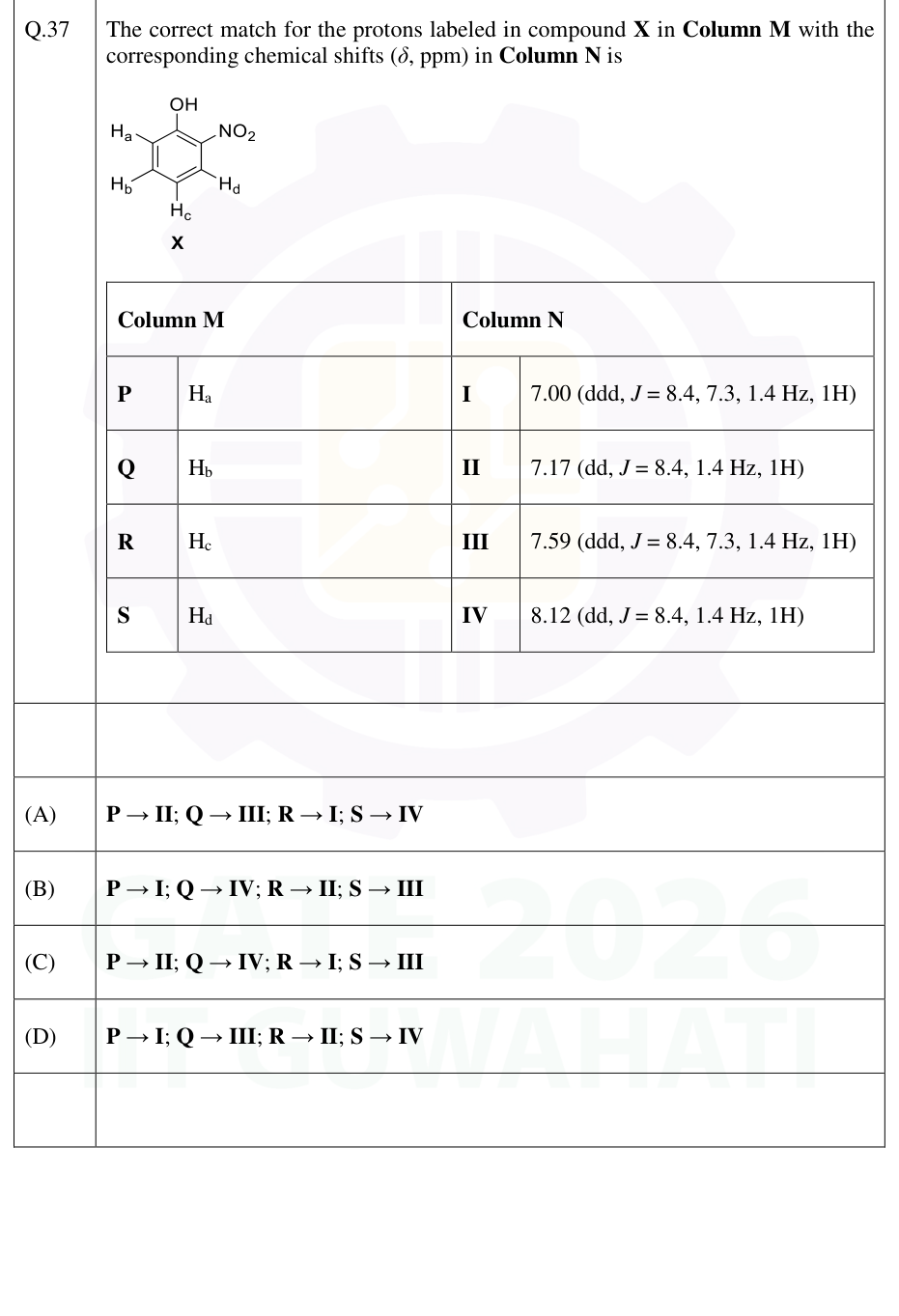
Match protons in compound X (Column M) with chemical shifts (Column N).
| Column M | Column N |
|---|---|
| P: Ha | I: 7.00 (ddd, J = 8.4, 7.3, 1.4 Hz, 1H) |
| Q: Hb | II: 7.17 (dd, J = 8.4, 1.4 Hz, 1H) |
| R: Hc | III: 7.59 (ddd, J = 8.4, 7.3, 1.4 Hz, 1H) |
| S: Hd | IV: 8.12 (dd, J = 8.4, 1.4 Hz, 1H) |
Practise this question in The GATE Grind →
Show answer and explanation
Correct answer: (A) P → II; Q → III; R → I; S → IV
Explanation
The proton next to nitro (Hd) is most downfield at 8.12 ppm; Ha beside hydroxyl is 7.17 ppm. Hb is para to nitro and Hc para to hydroxyl, giving 7.59 and 7.00 ppm respectively.