The GATE Grind

GATE 2026 CY – Question 40

Physical Chemistry · Group Theory: Symmetry elements and symmetry operations. Basic postulates of groups and group multiplication tables. Classes, reducible and irreducible representations of symmetry elements. Classification and labelling of molecular point groups. Symmetry based selection rules and their application to electronic and vibrational spectroscopy. Internal coordinates and symmetry labelling of vibrational modes; symmetry adapted linear combination of atomic orbitals (LCAO-MO); construction of hybrid orbitals using molecular point group symmetry. · 2 marks · Multiple choice

With metal M and monodentate ligands L numbered as shown, the sigma ligand-group orbital with the same symmetry as $d_{z^2}$ in octahedral geometry is
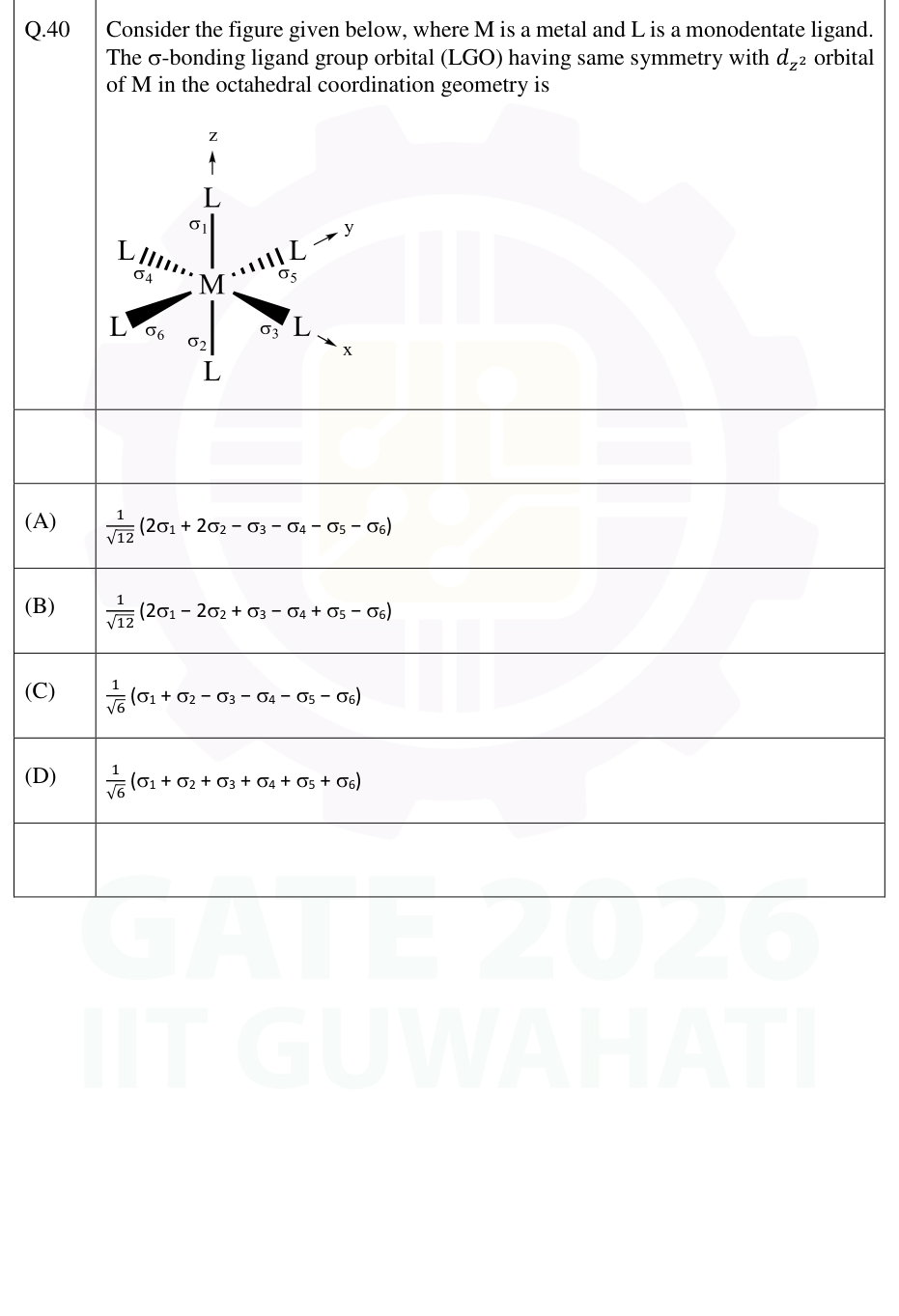
Octahedral coordination axes and ligand sigma orbitals numbered 1–6.
  1. $(2\sigma_1+2\sigma_2-\sigma_3-\sigma_4-\sigma_5-\sigma_6)/\sqrt{12}$
  2. $(2\sigma_1-2\sigma_2+\sigma_3-\sigma_4+\sigma_5-\sigma_6)/\sqrt{12}$
  3. $(\sigma_1+\sigma_2-\sigma_3-\sigma_4-\sigma_5-\sigma_6)/\sqrt6$
  4. $(\sigma_1+\sigma_2+\sigma_3+\sigma_4+\sigma_5+\sigma_6)/\sqrt6$

Practise this question in The GATE Grind →

Show answer and explanation

Correct answer: (A) $(2\sigma_1+2\sigma_2-\sigma_3-\sigma_4-\sigma_5-\sigma_6)/\sqrt{12}$

Explanation

The dz² orbital has equal-sign large axial lobes and opposite-sign equatorial amplitude. Normalization of coefficients 2,2,−1,−1,−1,−1 gives $1/\sqrt{12}$.