GATE 2024 PH – Question 53
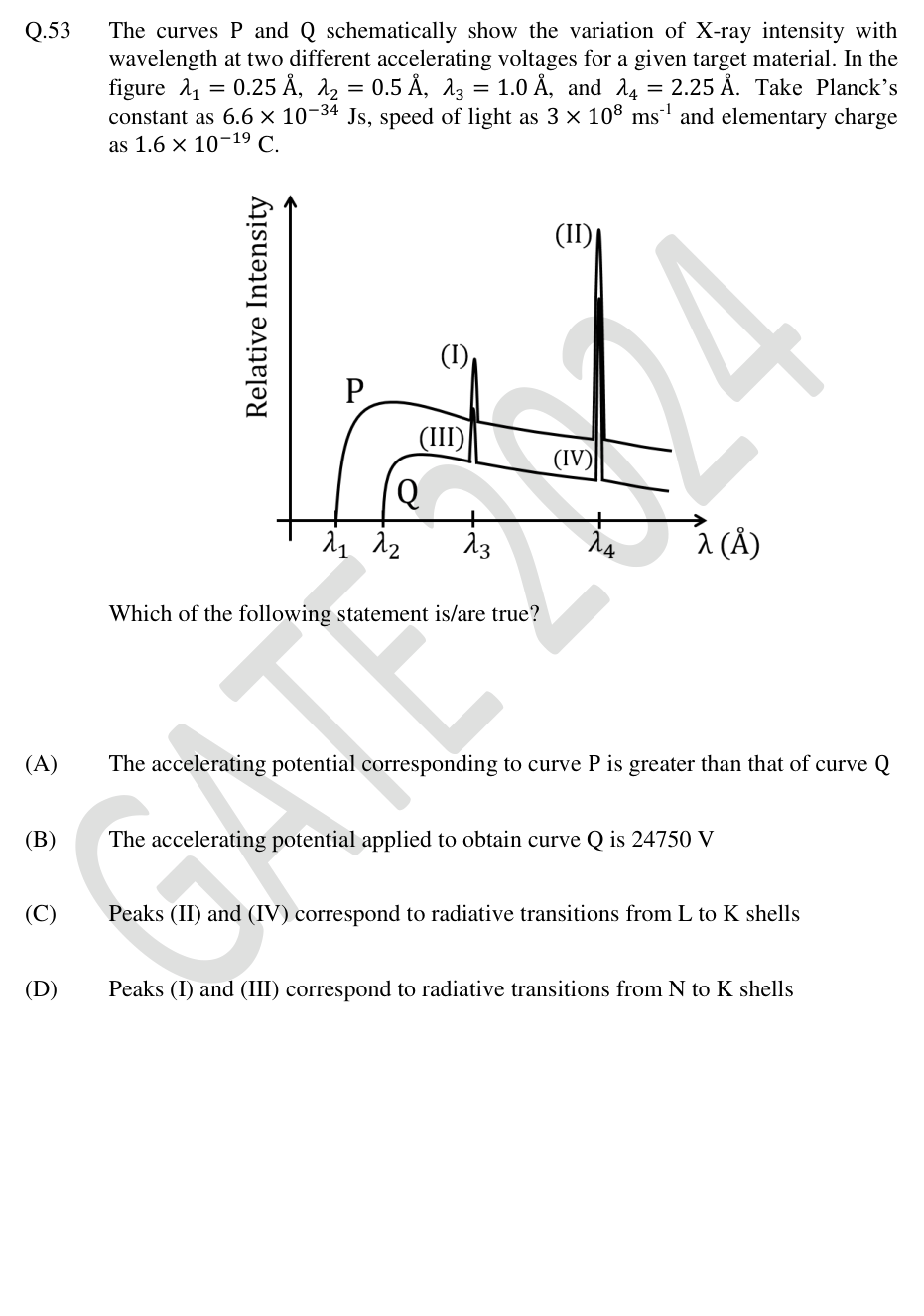
Curves P and Q give X-ray intensity versus wavelength at different accelerating voltages for the same target. $\lambda_1=0.25$ Å, $\lambda_2=0.5$ Å, $\lambda_3=1.0$ Å, $\lambda_4=2.25$ Å. Given $h=6.6\times10^{-34}$ J s, $c=3\times10^8$ m/s, $e=1.6\times10^{-19}$ C. Which statement(s) is/are true?
Practise this question in The GATE Grind →
Show answer and explanation
Correct answer: (A) The accelerating potential corresponding to curve P is greater than that of curve Q; (B) The accelerating potential applied to obtain curve Q is 24750 V; (C) Peaks (II) and (IV) correspond to radiative transitions from L to K shells
Explanation
The smaller cutoff wavelength of P means larger voltage. For Q, $V=hc/(e\lambda_2)=24750$ V. The longer-wavelength characteristic peak is K-alpha (L to K); the shorter is ordinarily K-beta (M to K).