GATE 2024 PH – Question 55
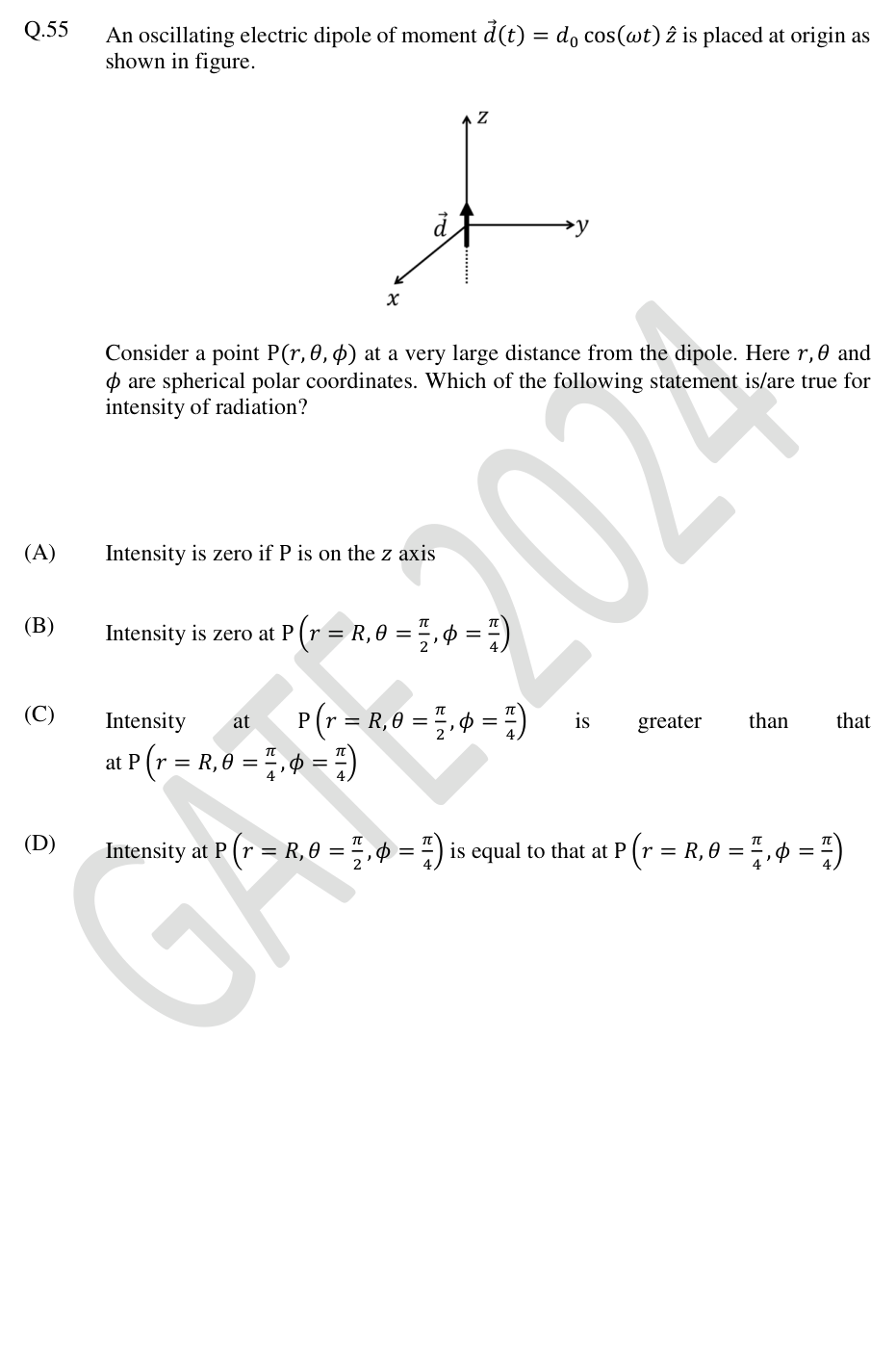
An oscillating dipole $\mathbf d(t)=d_0\cos(\omega t)\hat z$ is at the origin. For distant points in spherical coordinates, which intensity statements are true?
Practise this question in The GATE Grind →
Show answer and explanation
Correct answer: (A) Zero on the z axis; (C) At $(R,\pi/2,\pi/4)$ greater than at $(R,\pi/4,\pi/4)$
Explanation
An oscillating electric dipole radiates with an angular distribution of the intensity (time-averaged Poynting vector)
$$I(r,\theta)\propto\frac{\sin^2\theta}{r^2},$$
where $\theta$ is measured from the dipole axis ($z$). It is independent of the azimuth $\phi$.
- **A. Zero on the $z$ axis.** On the axis $\theta=0$ or $\pi$, so $\sin\theta=0$ and the intensity vanishes. ✓
- **B. Zero at $(R,\pi/2,\pi/4)$.** There $\theta=\pi/2$, $\sin^2\theta=1$, the maximum. ✗
- **C. Larger at $(R,\pi/2,\pi/4)$ than at $(R,\pi/4,\pi/4)$.** At $\theta=\pi/2$: $\sin^2=1$. At $\theta=\pi/4$: $\sin^2=\tfrac12$. So the first is twice the second. ✓
- **D. Equal at both points.** ✗
Answer **A and C**.