GATE 2026 PH – Question 16
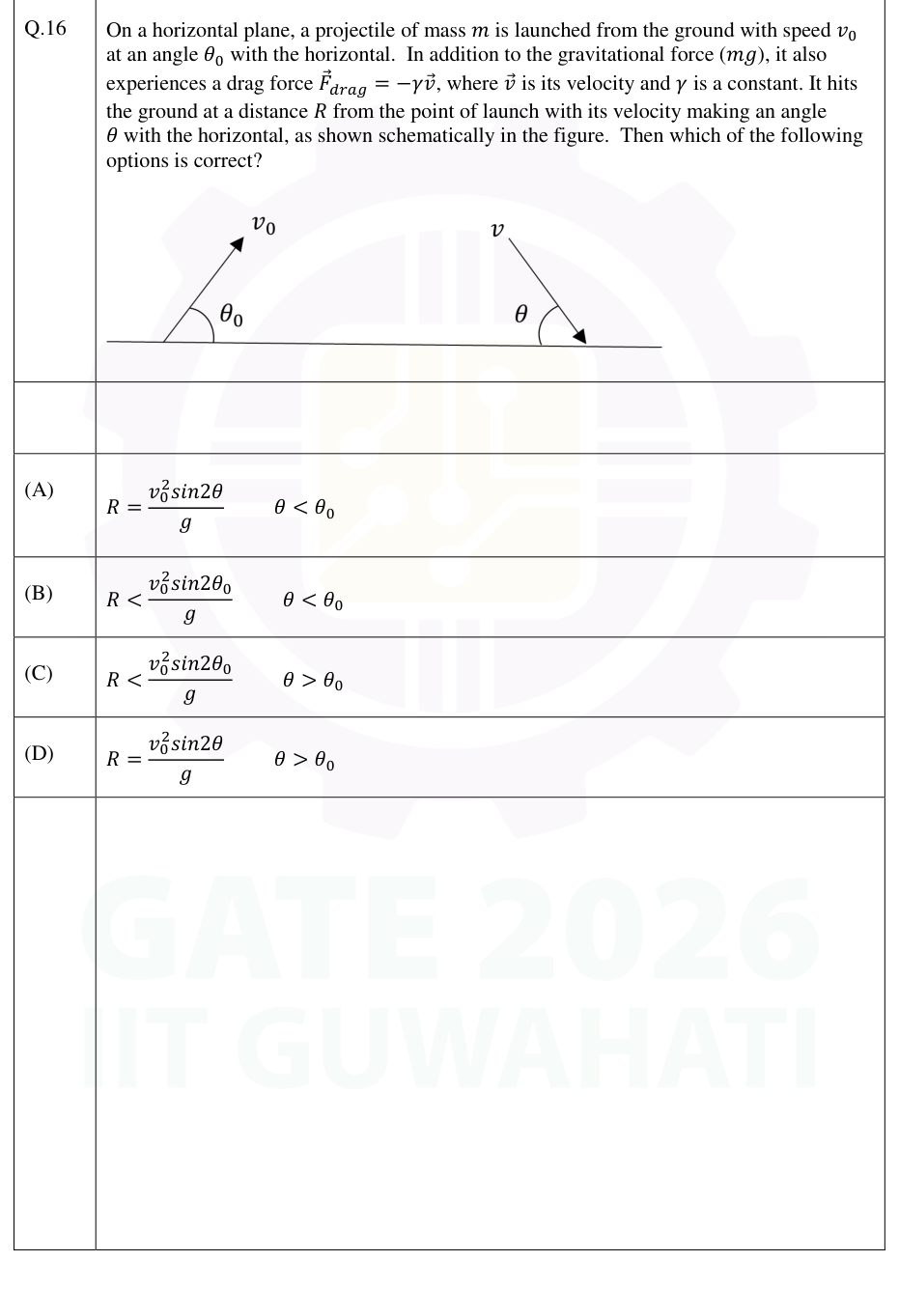
On a horizontal plane, a projectile of mass $m$ is launched from the ground with speed $v_0$ at an angle $\theta_0$ with the horizontal. In addition to the gravitational force ($mg$), it also experiences a drag force $\mathbf F_{drag}=-\gamma\mathbf v$, where $\mathbf v$ is its velocity and $\gamma$ is a constant. It hits the ground at a distance $R$ from the point of launch with its velocity making an angle $\theta$ with the horizontal, as shown schematically in the figure. Then which of the following options is correct?
Practise this question in The GATE Grind →
Show answer and explanation
Correct answer: (C) $R<v_0^2\sin2\theta_0/g,\ \theta>\theta_0$
Explanation
With linear drag $\mathbf F=-\gamma\mathbf v$ the motion is damped.
**Range.** Without drag the range is $R_0=v_0^2\sin2\theta_0/g$. Drag removes kinetic energy throughout the flight, so the projectile covers a shorter horizontal distance:
$$R<\frac{v_0^2\sin2\theta_0}{g}.$$
This rules out options A and D (which claim equality).
**Landing angle.** The horizontal velocity decays throughout the flight ($\dot v_x=-\gamma v_x/m$), while the vertical velocity is reduced on the way up but pushed towards its terminal value on the way down. At the same height on the way down the horizontal speed is smaller than on the way up, so the descent is steeper than the launch:
$$\theta>\theta_0 .$$
Answer: $R<v_0^2\sin2\theta_0/g$ and $\theta>\theta_0$ (option C).