GATE 2026 PH – Question 22
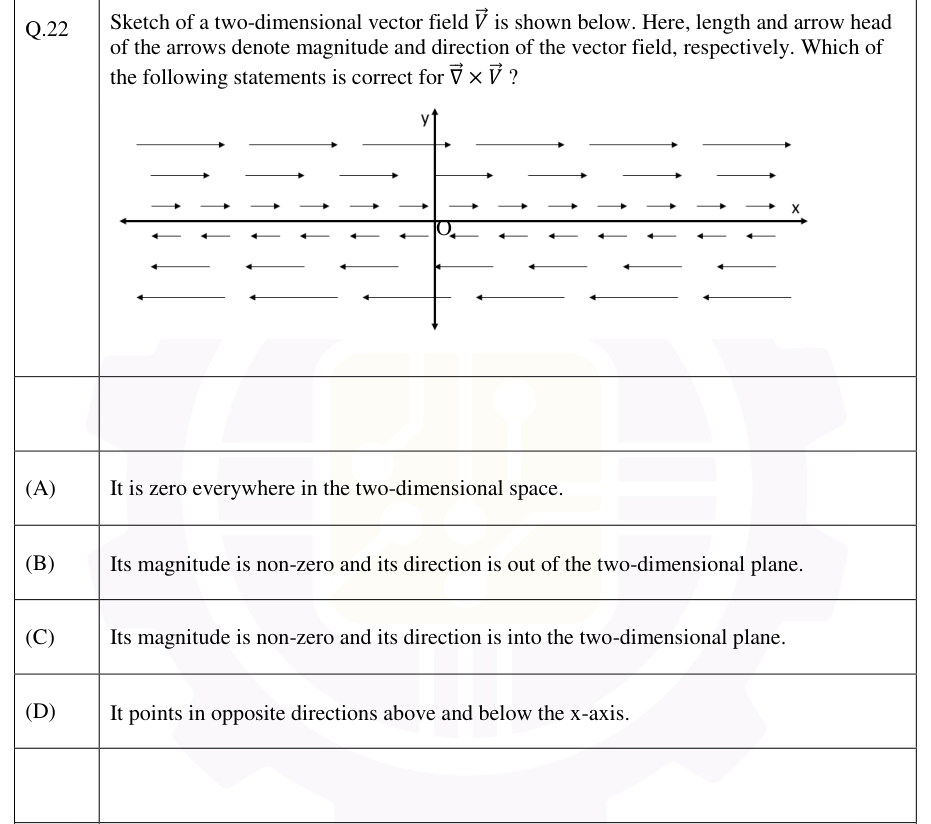
Sketch of a two-dimensional vector field V⃗ is shown below. Here, length and arrow head of the arrows denote magnitude and direction of the vector field, respectively. Which of the following statements is correct for ∇⃗⃗ × V⃗ ?
Practise this question in The GATE Grind →
Show answer and explanation
Correct answer: (C) Its magnitude is non-zero and its direction is into the two-dimensional plane.
Explanation
The sketch shows a two-dimensional field with only a horizontal component that depends on $y$:
$$\mathbf V=V_x(y)\,\hat x,$$
where $V_x>0$ above the $x$-axis and $V_x<0$ below it, and $|V_x|$ grows with the distance from the axis. So $V_x$ increases with $y$: $\dfrac{dV_x}{dy}>0$.
**Curl:**
$$(\nabla\times\mathbf V)_z=\frac{\partial V_y}{\partial x}-\frac{\partial V_x}{\partial y}=-\frac{dV_x}{dy}<0 .$$
The curl is non-zero and points along $-\hat z$, **into the plane** of the sketch (taking $\hat z$ out of the plane). It has the same direction everywhere, above and below the axis, since $dV_x/dy>0$ everywhere.
Answer: non-zero magnitude and directed into the plane (option C).