GATE 2026 PH – Question 43
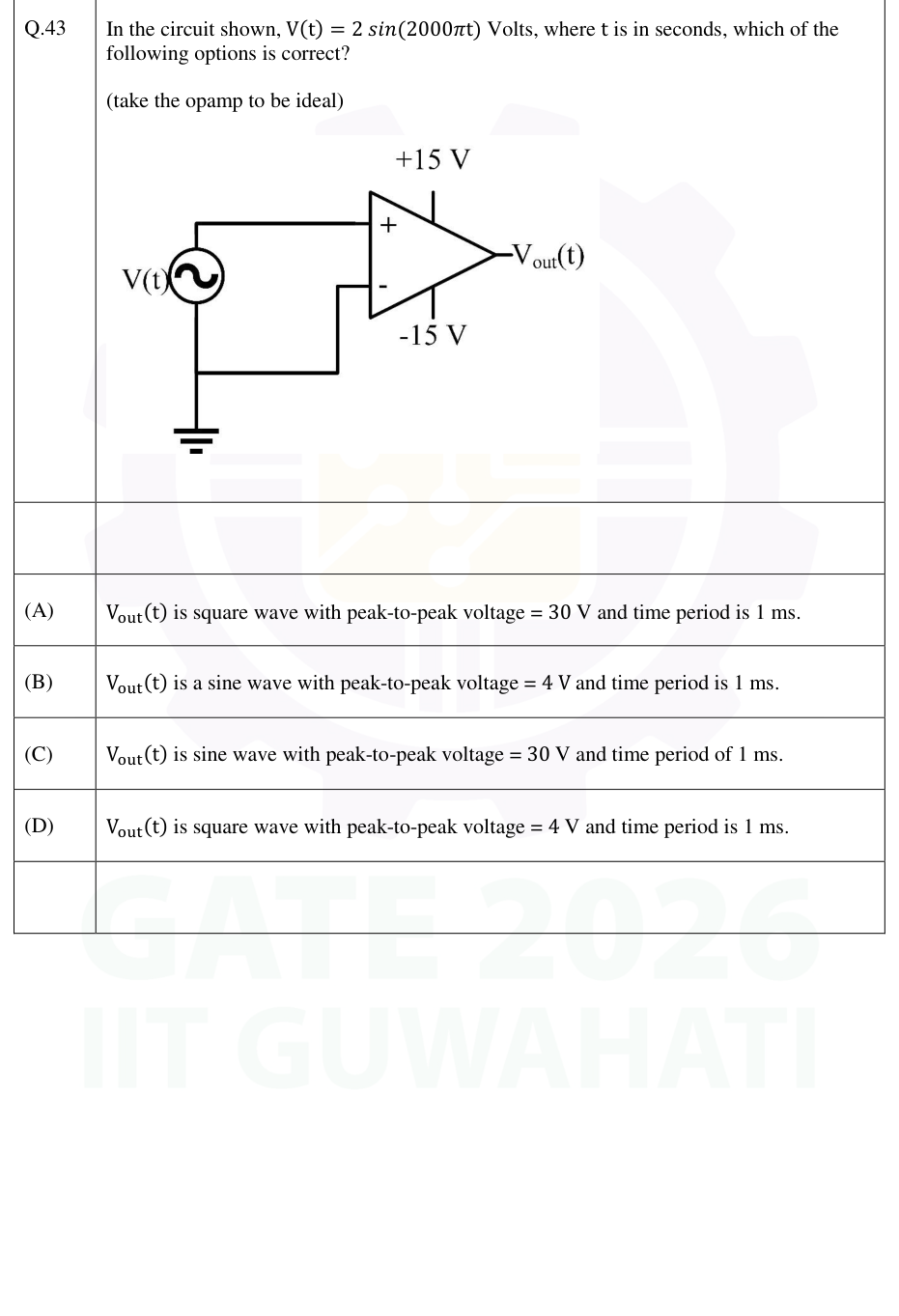
In the circuit shown, V(t) = 2 sin(2000πt) Volts, where t is in seconds, which of the following options is correct? (take the opamp to be ideal)
Practise this question in The GATE Grind →
Show answer and explanation
Correct answer: (A) Vout(t) is square wave with peak-to-peak voltage = 30 V and time period is 1 ms.
Explanation
The op-amp has **no negative feedback** (the output is not connected back to the inverting input), so it works in open loop with a very large gain. In this case it behaves as a **comparator**:
- when the non-inverting input is above the inverting input (0 V), the output saturates at the positive rail, $+15$ V;
- when it is below, the output saturates at the negative rail, $-15$ V.
**Output:** a **square wave** that switches between $+15$ V and $-15$ V, so the peak-to-peak voltage is
$$15-(-15)=30\text{ V}.$$
**Period.** The input $V(t)=2\sin(2000\pi t)$ has angular frequency $2000\pi$ rad/s, so its frequency is $f=1000$ Hz and its period is $T=\dfrac1f=1$ ms. The output has the same period.
Answer: a square wave with 30 V peak-to-peak and period 1 ms (option A).