GATE 2026 PH – Question 60
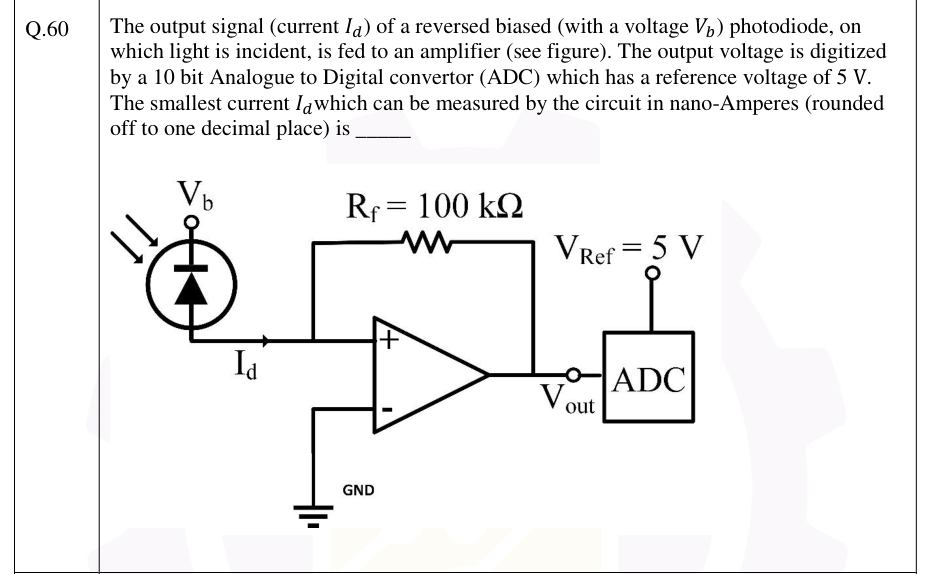
The output signal (current Id) of a reversed biased (with a voltage Vb) photodiode, on which light is incident, is fed to an amplifier (see figure). The output voltage is digitized by a 10 bit Analogue to Digital convertor (ADC) which has a reference voltage of 5 V. The smallest current Idwhich can be measured by the circuit in nano-Amperes (rounded off to one decimal place) is _____
Practise this question in The GATE Grind →
Show answer and explanation
Correct answer: 48.56 to 49.04
Explanation
The photodiode current $I_d$ is converted to a voltage by the amplifier (a transimpedance stage). With the feedback resistor $R_f=100\text{ k}\Omega=10^5\ \Omega$, the output voltage is
$$V=I_dR_f .$$
**ADC resolution.** A 10-bit converter with reference 5 V divides the range into $2^{10}=1024$ steps, so the smallest voltage step it can resolve (1 LSB) is
$$V_{LSB}=\frac{5}{1024}=4.883\times10^{-3}\text{ V}.$$
**Smallest measurable current:**
$$I_{min}=\frac{V_{LSB}}{R_f}=\frac{4.883\times10^{-3}}{10^5}=4.883\times10^{-8}\text{ A}=\mathbf{48.8\ nA}.$$