GATE 2020 CS – Question 8
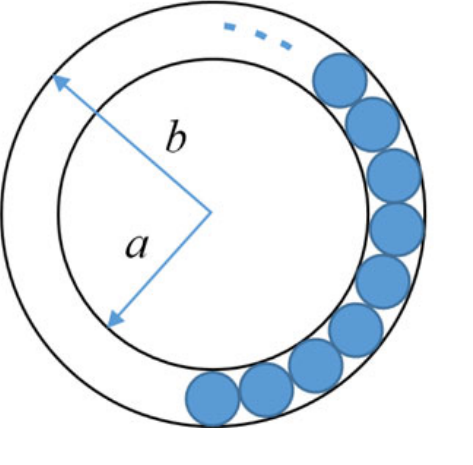
The figure below shows an annular ring with outer and inner radii as $b$ and $a$, respectively. The annular space has been painted in the form of blue colour circles touching the outer and inner periphery of annular space. If maximum $n$ number of circles can be painted, then the unpainted area available in annular space is ______.
Practise this question in The GATE Grind →
Show answer and explanation
Correct answer: (A) $\pi\left[(b^2-a^2)-\frac{n}{4}(b-a)^2\right]$
Explanation
Let each painted circle have radius r and its centre be at distance ρ from the annulus centre. Tangency to both boundaries gives ρ−r=a and ρ+r=b. Subtracting yields $r=(b-a)/2$.
Each painted circle therefore has area $\pi(b-a)^2/4$. Subtract the n non-overlapping painted circles from the annular area:
$$A_{\rm unpainted}=\pi(b^2-a^2)-n\frac{\pi(b-a)^2}{4}.$$
This is **A**. The radial thickness b−a is the small circle's diameter, not its radius; n is supplied symbolically, so it need not be calculated.
More Quantitative Aptitude: Algebra, Geometry and Mensuration questions
All Quantitative Aptitude: Algebra, Geometry and Mensuration questions →