GATE 2016 ME (ME2) – Question 41
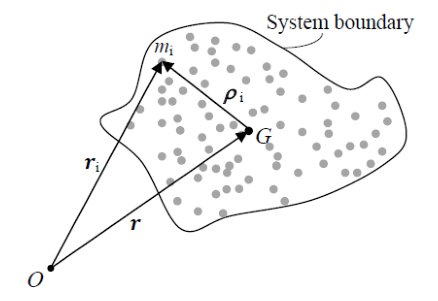
A moving particle system has mass centre G. Particle i has mass $m_i$, position $\mathbf r_i$ from fixed O and position $\boldsymbol\rho_i$ from G, as shown. Dots denote time derivatives. The time rate of change of angular momentum about G is ______.
Practise this question in The GATE Grind →
Show answer and explanation
Correct answer: (B) $\sum_i\boldsymbol\rho_i\times m_i\ddot{\mathbf r}_i$; (D) $\sum_i\boldsymbol\rho_i\times m_i\ddot{\boldsymbol\rho}_i$
Explanation
Relative angular momentum is the sum of ρi cross mi times relative velocity. Differentiation leaves Σρi cross miρi-double-prime because a vector crossed with itself is zero, giving D. Since Σmiρi=0, adding the common mass-centre acceleration changes no moment, giving equivalent expression B with absolute acceleration. The official MCQ accepts **B OR D**; algebraically A also reduces to D when the exact mass-centre identity Σmiρi-double-prime=0 is imposed.