GATE 2024 EC – Question 13
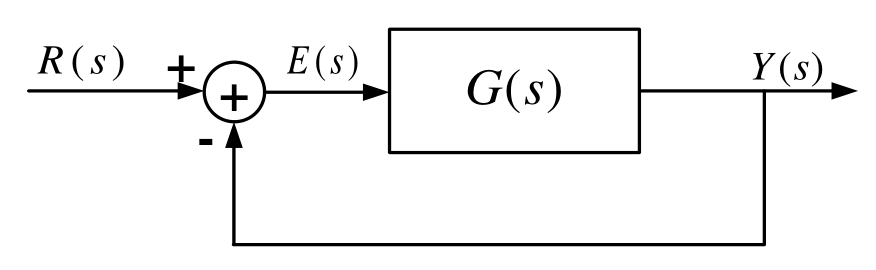
In the feedback control system shown in the figure below, $G(s)=\dfrac{6}{s(s+1)(s+2)}$.
$R(s)$, $Y(s)$, and $E(s)$ are the Laplace transforms of $r(t)$, $y(t)$, and $e(t)$, respectively.
If the input $r(t)$ is a unit step function, then ____________.
Practise this question in The GATE Grind →
Show answer and explanation
Correct answer: (D) $\lim_{t\to\infty}e(t)$ does not exist, $e(t)$ is oscillatory
Explanation
The closed-loop characteristic equation is $s(s+1)(s+2)+6=s^3+3s^2+2s+6=(s+3)(s^2+2)=0$, with roots $-3$ and $\pm j\sqrt2$. The poles on the imaginary axis make the system marginally stable, so the error contains an undamped sinusoid $\cos(\sqrt2t)$. The final value theorem cannot be applied (it would wrongly give 0 for a type-1 system), so $\lim_{t\to\infty}e(t)$ does not exist and $e(t)$ oscillates.