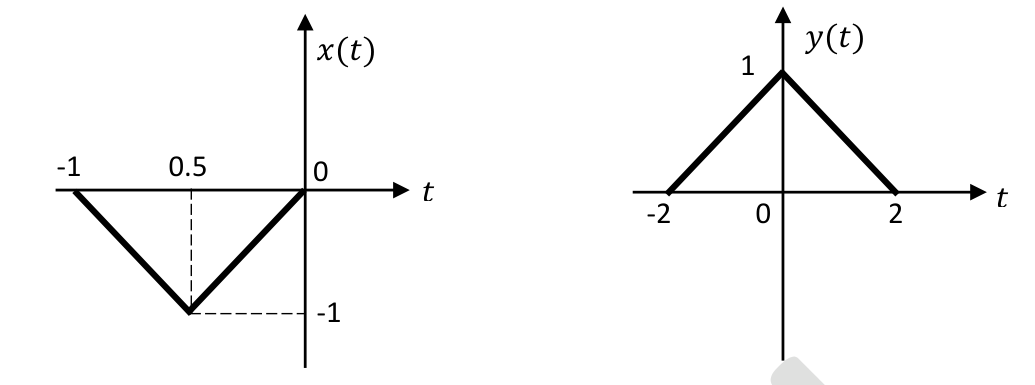
$x(t)$ is a triangle of height $-1$ centred at $t=-0.5$ with half-width 0.5. $y(t)$ is a triangle of height $+1$ centred at $t=0$ with half-width 2. So $y(t)$ is $x$ stretched by a factor 4 (half-width 0.5 to 2), inverted, and shifted: $y(t)=-x\!\left(\dfrac{t}{4}-0.5\right)=-x\!\left(\dfrac{t-2}{4}\right)$. Time scaling gives $x(t/4)\leftrightarrow4X(4f)$, and the delay by 2 gives $e^{-j2\pi f\cdot2}=e^{-j4\pi f}$. Hence $Y(f)=-4X(4f)e^{-j4\pi f}$.
More Continuous-time Signals questions
GATE 2024 EC Q48– A continuous time signal x(t)=2(8 t+/3) is sampled at a rate of 15 Hz. The sampled signal…
GATE 2023 EC Q28– The Fourier transform X() of x(t)=e-t2 is Note: -e-y2dy=
GATE 2023 EC Q29– In the table shown below, match the signal type with its spectral characteristics. Signal…
GATE 2023 EC Q49– Let x(t)=10(10.5Wt) be passed through an LTI system having impulse response h(t)=( Wt…
GATE 2022 EC Q15– The Fourier transform X(j) of the signal x(t)=t(1+t2)2 is .
GATE 2022 EC Q33– Let x 1(t)=e-tu(t) and x 2(t)=u(t)-u(t-2), where u() denotes the unit step function. If…