GATE 2014 EE (EE2) – Question 17
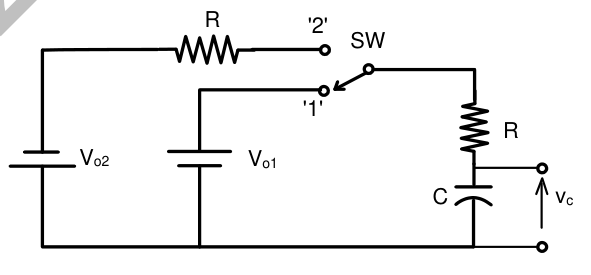
SW remains at 1 for a long time, then moves to 2 at t = 0⁺. Given |V₀₂| > |V₀₁|, find capacitor voltage v_c(t).
Practise this question in The GATE Grind →
Show answer and explanation
Correct answer: (D) $(V_{o2}-V_{o1})(1-e^{-t/(2RC)})+V_{o1}$
Explanation
A capacitor retains its initial voltage V01. After switching,the two resistors are in series in its charging path,so τ=2RC. With V02 interpreted as the signed final capacitor voltage,the universal first-order result is vc=V02+(V01−V02)e^(−t/2RC)=(V02−V01)(1−e^(−t/2RC))+V01, **D**. The source polarities must be included in the signed V02; if both labels denote unsigned battery magnitudes,the drawn reversed second source would instead give final voltage−V02.