Networks, Signals and Systems · LTI Systems · 2 marks · Numerical answer
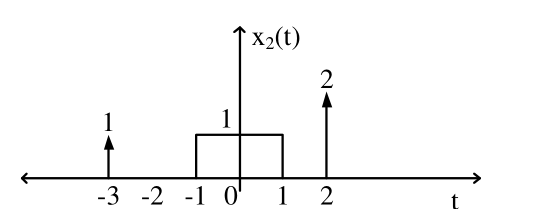
Let $x_1(t)=u(t+1.5)-u(t-1.5)$ and $x_2(t)$ is shown in the figure below. For $y(t)=x_1(t)*x_2(t)$, the $\int_{-\infty}^{\infty}y(t)\,dt$ is ________ (rounded off to the nearest integer).
The area of a convolution is the product of the areas: $\int y\,dt=\int x_1\,dt\cdot\int x_2\,dt$. $x_1$ is a rectangle of width 3 and height 1, area 3. $x_2$ consists of an impulse of weight 1 at $t=-3$, a rectangle of height 1 from $-1$ to $1$ (area 2) and an impulse of weight 2 at $t=2$: total area $1+2+2=5$. So $\int y\,dt=3\times5=15$.
More LTI Systems questions
GATE 2022 EC Q46– The outputs of four systems (S 1, S 2, S 3, and S 4) corresponding to the input signal…
GATE 2021 EC Q50– For a unit step input u[n], a discrete-time LTI system produces an output signal…
GATE 2020 EC Q15– The output y[n] of a discrete-time system for an input x[n] is y[n]= - k n x[k] . The unit…
GATE 2019 EC Q15– Let Y(s) be the unit-step response of a causal system having a transfer function…
GATE 2018 EC Q14– Let the input be u and the output be y of a system, and the other parameters are real…
GATE 2016 EC Q16– Which one of the following is an eigen function of the class of all continuous-time,…