GATE 2026 EE – Question 19
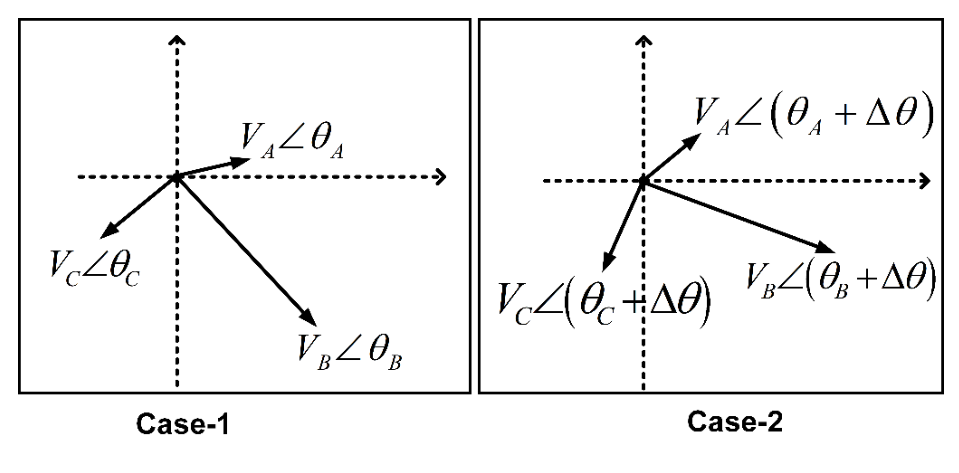
The initial three-phase voltage phasors ($\bar V_A$, $\bar V_B$, and $\bar V_C$) at a bus of a power network are as shown in Case-1. Due to a disturbance, the bus voltage phasors changed in phase by a small angle $\Delta\theta$, and the magnitudes remained the same as depicted in Case-2.
Which one of the following statements is correct about the zero sequence components?
Practise this question in The GATE Grind →
Show answer and explanation
Correct answer: (D) The zero sequence components in Case-1 and Case-2 have the same magnitude but different phase angles
Explanation
The zero sequence component is $\bar V_0=\frac13(\bar V_A+\bar V_B+\bar V_C)$. In Case-2 every phasor is rotated by the same angle $\Delta\theta$, so $\bar V_0$ is multiplied by $e^{j\Delta\theta}$: the magnitude is unchanged and the phase angle changes by $\Delta\theta$.