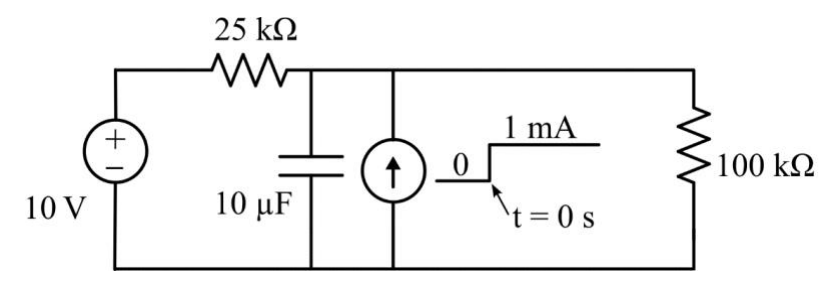
Before $t=0$ the capacitor sits at the divider voltage $10\times\dfrac{100}{25+100}=8$ V, and it cannot jump: $v(0^+)=8$ V. For $t>0$ the 1 mA source pushes current into the node. The Thevenin resistance seen by the capacitor is $25\text{ k}\|100\text{ k}=20$ kΩ, so $\tau=20\text{ k}\times10\ \mu\text{F}=0.2$ s, and the final voltage is $8+1\text{ mA}\times20\text{ k}=28$ V. $v(t)=28-20e^{-t/0.2}$, so $v(0.5)=28-20e^{-2.5}=26.36$ V.
More Transient response of DC and AC networks, sinusoidal steady-state analysis, resonance, two port networks, balanced three phase circuits, star-delta transformation, complex power and power factor in AC circuits questions
GATE 2025 EE Q57– The switch (S) closes at t=0 sec. The time, in sec, the capacitor takes to charge to 50 V…
GATE 2024 EE Q14– The circuit shown in the figure with the switch S open, is in steady state. After the…
GATE 2023 EE Q29– The value of parameters of the circuit shown in the figure are R 1=2\ , R 2=2\ , R 3=3\ ,…
GATE 2023 EE Q54– The circuit shown in the figure is initially in the steady state with the switch K in open…
GATE 2022 EE Q21– In the circuit shown below, a three-phase star-connected unbalanced load is connected to a…
GATE 2022 EE Q27– An inductor having a Q-factor of 60 is connected in series with a capacitor having a…