GATE 2026 EE – Question 58
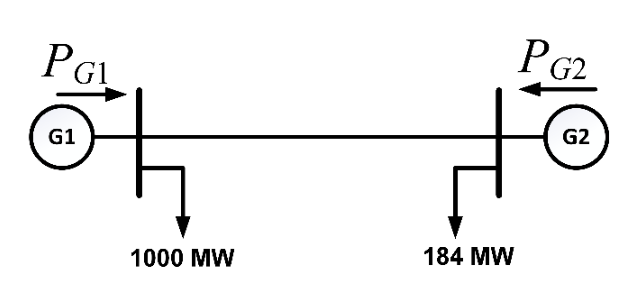
A system with two generators G1 and G2 (without generator limits) is shown.
The total load on the system is 1184 MW. The expressions for the cost of generation ($C_1$ and $C_2$) and real power loss ($P_{Loss}$) are as follows:
$C_1(P_{G1})=1000+50P_{G1}+0.01(P_{G1})^2$ Rs/MWh
$C_2(P_{G2})=2000+50P_{G2}+0.001(P_{G2})^2$ Rs/MWh
$P_{Loss}=0.001(P_{G2}-50)^2$ MW
When the generators are operating at their optimal generation, meeting the total load requirement, the real power loss in the system is ________ MW. (Round off to one decimal place)
Consider the Lagrange multiplier $\lambda=70.25$ for optimal generation.
Practise this question in The GATE Grind →
Show answer and explanation
Correct answer: 19.90 to 20.10
Explanation
For generator 1 (no loss penalty), $\dfrac{dC_1}{dP_{G1}}=\lambda$: $50+0.02P_{G1}=70.25$, so $P_{G1}=1012.5$ MW. The power balance is $P_{G1}+P_{G2}=1184+P_{Loss}$, i.e. $P_{G2}=171.5+0.001(P_{G2}-50)^2$, which gives $0.001P_{G2}^2-1.1P_{G2}+174=0$ and $P_{G2}=\dfrac{1.1-\sqrt{1.21-0.696}}{0.002}=191.5$ MW. Then $P_{Loss}=0.001(191.5-50)^2=20.0$ MW. (Check: $\dfrac{50+0.002(191.5)}{1-0.002(141.5)}=70.27\approx\lambda$.)