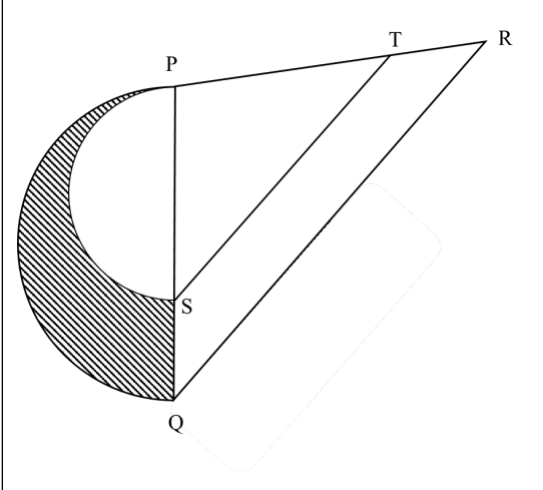
Correct answer: (A) The shaded area is $\dfrac{16}{9}$ times the area of the semicircle with the diameter PS.
Explanation
Since $ST\parallel QR$, $\dfrac{PS}{PQ}=\dfrac{PT}{PR}=\dfrac35$. The shaded region is the large semicircle (diameter PQ) minus the small one (diameter PS). Semicircle areas are proportional to the square of the diameter, so with $PS=3$ and $PQ=5$: shaded $=\dfrac{5^2-3^2}{3^2}=\dfrac{16}{9}$ times the semicircle on PS.
More Quantitative Aptitude: Algebra, Geometry and Mensuration questions
GATE 2024 EE Q5– If, for non-zero real variables x, y, and real parameter a>1, x:y=(a+1):(a-1), then, the…
GATE 2024 EE Q7– In the following figure, CD = 5 cm, BE = 10 cm, AE = 12 cm, ∠DAB = ∠DCB, and ∠DAE = ∠DBC =…
GATE 2024 EE Q10– A surveyor has to measure the horizontal distance from her position to a distant reference…
GATE 2023 EE Q7– Which one of the following options represents the given graph?
GATE 2023 EE Q10– A square with sides of length 6 cm is given. The boundary of the shaded region is defined…
GATE 2022 EC Q3– A trapezium has vertices marked as P, Q, R and S (in that order anticlockwise). The side…