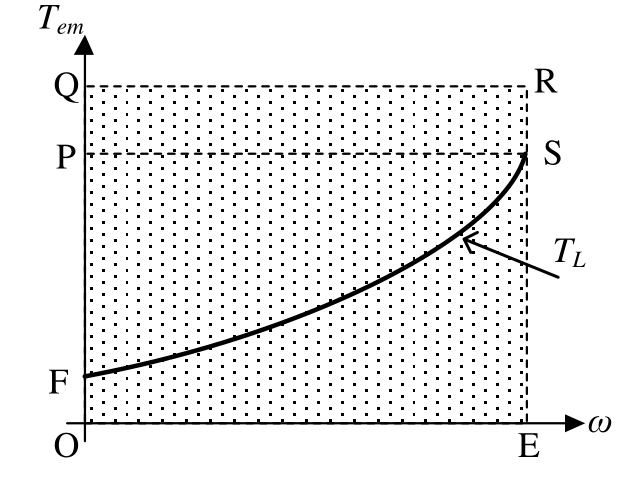
The operating region of the developed torque ($T_{em}$) and speed ($\omega$) of an induction motor drive is given by the shaded region OQRE in the figure. The load torque ($T_L$) characteristic is also shown. The motor drive moves from the initial operating point O to the final operating point S. Which one of the following trajectories will take the shortest time?
The acceleration is $\dfrac{T_{em}-T_L}{J}$, so the fastest way to reach S is to apply the maximum available torque throughout. That means going from O straight up to the maximum torque Q, then along the maximum-torque boundary QR to the maximum speed, and only then coming down to S. So the trajectory is O − Q − R − S.
More DC machines: separately excited, series and shunt, motoring and generating mode of operation and their characteristics, speed control of dc motors questions
GATE 2025 EE Q44– A DC series motor with negligible series resistance is running at a certain speed driving…
GATE 2024 EE Q55– A 5 kW, 220 V DC shunt motor has 0.5 Ω armature resistance including brushes. The motor…
GATE 2023 EE Q30– A separately excited DC motor rated 400 V, 15 A, 1500 RPM drives a constant torque load at…
GATE 2022 EE Q62– A 280 V, separately excited DC motor with armature resistance of 1\ and constant field…
GATE 2021 EE Q54– A belt-driven DC shunt generator running at 300 RPM delivers 100 kW to a 200 V DC grid. It…
GATE 2020 EE Q38– A 250 V dc shunt motor has an armature resistance of 0.2\ and a field resistance of 100\ .…