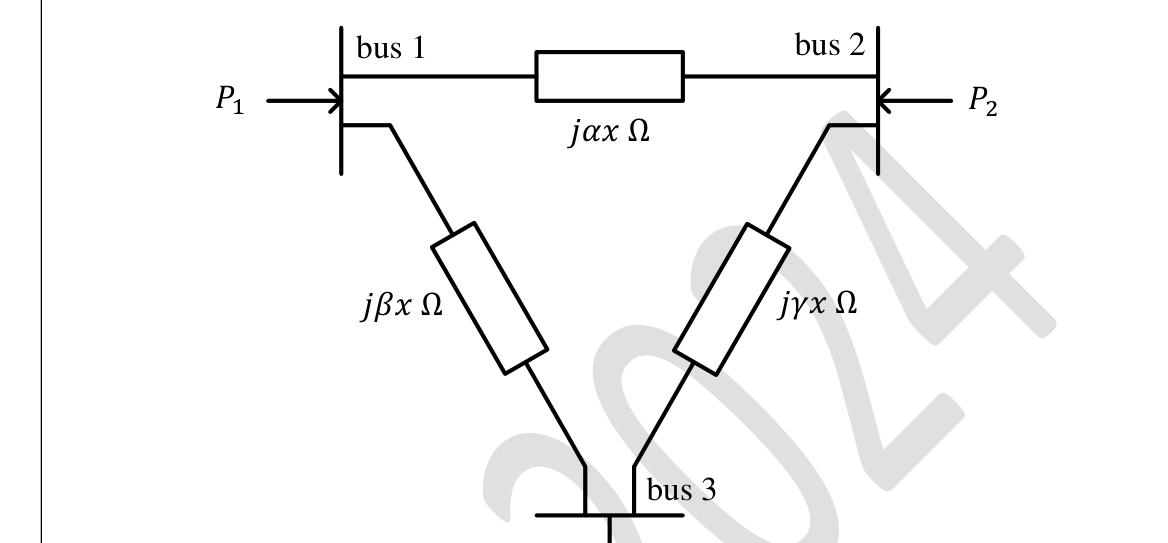
For the three-bus lossless power network shown in the figure, the voltage magnitudes at all the buses are equal to 1 per unit (pu), and the differences of the voltage phase angles are very small. The line reactances are marked in the figure, where $\alpha$, $\beta$, $\gamma$, and $x$ are strictly positive. The bus injections $P_1$ and $P_2$ are in pu. If $P_1=mP_2$, where $m>0$, and the real power flow from bus 1 to bus 2 is 0 pu, then which one of the following options is correct?
For small angle differences, $P_{ij}=\dfrac{\theta_i-\theta_j}{X_{ij}}$. Zero flow from bus 1 to bus 2 means $\theta_1=\theta_2$. Then bus 1 delivers all of $P_1$ to bus 3 through the $\beta x$ line, $P_1=\dfrac{\theta_1-\theta_3}{\beta x}$, and bus 2 delivers $P_2=\dfrac{\theta_2-\theta_3}{\gamma x}$. Since $\theta_1=\theta_2$, $\dfrac{P_1}{P_2}=\dfrac{\gamma}{\beta}=m$, i.e. $\gamma=m\beta$.
More Basic concepts of electrical power generation, AC and DC transmission concepts, Models and performance of transmission lines and cables questions
GATE 2023 EE Q33– A 50 Hz, 275 kV line of length 400 km has the following parameters: Resistance, R=0.035\…
GATE 2023 EE Q64– A balanced delta connected load consisting of the series connection of one resistor (R=15\…
GATE 2022 EE Q14– The geometric mean radius of a conductor, having four equal strands with each strand of…
GATE 2022 EE Q30– If only 5% of the supplied power to a cable reaches the output terminal, the power loss in…
GATE 2021 EE Q25– Two single-core power cables have total conductor resistances of 0.7\ and 0.5\ ,…
GATE 2019 EE Q53– The voltage across and the current through a load are expressed as follows…