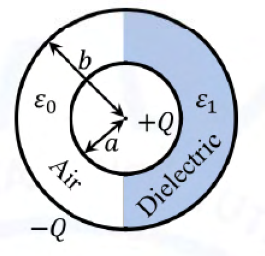
Two concentric conducting spherical shells have radii $a,b$ and charges $+Q,-Q$, respectively. Half the space between them is filled with a hemispherical dielectric of permittivity $\epsilon_1$; the other half contains air of permittivity $\epsilon_0$. For $a<r<b$, the electric field is
The dielectric interface is radial, so a radial electric field is tangential to it and must be continuous. Thus the field has the same magnitude in both hemispheres. Apply Gauss’s law to displacement: $Q=2\pi r^2\epsilon_0E+2\pi r^2\epsilon_1E$. Solving gives $E=Q/[2\pi(\epsilon_0+\epsilon_1)r^2]$, directed radially outward. The free charge redistributes between the hemispheres; it is not divided equally in general.
More Dielectrics and conductors questions
GATE 2024 PH Q40– A parallel capacitor has potential zero at x = 0 and V 0 at x = d, filled by = 0(1+x/d).…
GATE 2025 PH Q31– A linear dielectric sphere of radius R has a uniform frozen-in polarization along the…
GATE 2025 PH Q56– A neutral conducting sphere of radius R in uniform field E 0 z has outside potential…
GATE 2025 PH Q57– A point charge q is placed at the origin inside an infinite linear dielectric with…
GATE 2026 PH Q30– A dielectric sphere carries a uniform polarization P=26\ C\,cm-2. The magnitude of the…
GATE 2022 PH Q53– A parallel-plate capacitor of area A and spacing d stays connected to voltage V while…