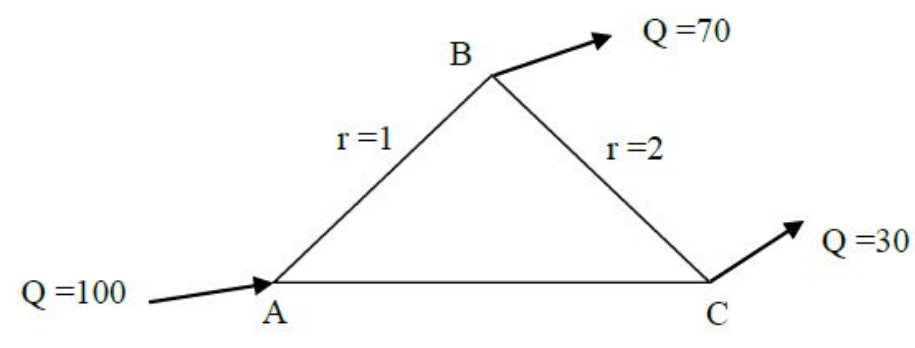
A triangular pipe network is shown. Head loss in each pipe is $h_f=rQ^{1.8}$ in consistent units. Pipe AB has $r=1$ and BC has $r=2$. A supply of 100 at A is split equally into AB and AC; withdrawals are 70 at B and 30 at C. Find the resistance coefficient $r$ of AC, to two decimal places.
Equal division gives $Q_{AB}=Q_{AC}=50$. B withdraws 70, so it also receives 20 from C through BC. Thus $H_A-H_B=50^{1.8}$ and $H_C-H_B=2(20^{1.8})$. Subtracting gives $H_A-H_C=50^{1.8}-2(20^{1.8})=r_{AC}50^{1.8}$. Hence $r_{AC}=1-2(20/50)^{1.8}=0.6156$, or 0.62.
More Flow in pipes and pipe networks questions
GATE 2026 CE (CE1) Q16– Two reservoirs having different water levels are connected by two long parallel pipelines…
GATE 2026 CE (CE2) Q54– A centrifugal pump is delivering water from an underground tank to an overhead reservoir…
GATE 2025 CE (CE2) Q33– Consider steady flow of water in the series pipe system shown below, with specified…
GATE 2024 CE (CE2) Q57– A 500 m long water distribution pipeline P with diameter 1.0 m, is used to convey 0.1 m3/s…
GATE 2022 CE (CE1) Q57– Two reservoirs are connected by two parallel pipes of equal length and of diameters 20 cm…
GATE 2020 CE (CE1) Q59– Reservoirs P, Q and R connect through pipes at junction S as shown. Piezometric head at S…