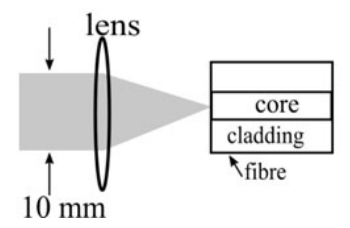
A 10 mm diameter laser beam is focused onto an optical fibre by a thin biconvex lens of refractive index 1.5. Fibre core and cladding indices are 1.55 and 1.54. Find the minimum focal length for maximum coupling in mm, to one decimal place.
For entry from air, numerical aperture is $NA=\sqrt{n_{core}^2-n_{clad}^2}=\sqrt{1.55^2-1.54^2}=0.175784$. The maximum acceptance half-angle is $\theta_a=\sin^{-1}(NA)$. A beam of radius 5 mm focused by the lens has marginal-ray angle satisfying $\tan\theta=5/f$. Require $\theta\leq\theta_a$, giving $f_{min}=5/\tan\theta_a=28.0$ mm. The lens index would enter a separate curvature design, not this coupling-angle constraint.
More Interferometry and fiber-optic sensing: Interferometers and their applications in metrology, basics of fibre optic sensing, near-infrared (NIR) sensing, UV-VIS spectrophotometers, mass spectrometer questions
GATE 2020 IN Q57– A slab of refractive index 1.5 and thickness t is surrounded by air on both sides. Light…
GATE 2026 IN Q64– For a fiber Bragg grating-based sensor, the shift in the Bragg wavelength gives…
GATE 2025 IN Q55– The shown Michelson interferometer measures a gas refractive index. Its transparent…
GATE 2023 IN Q45– A silica-glass fibre has core index 1.47 and cladding index 1.44. The cladding is…
GATE 2022 IN Q39– A car moves collinearly with a transceiver’s laser beam. A pulse emitted at t=0 returns…
GATE 2021 IN Q32– A Michelson interferometer’s movable arm is displaced 325 μm in vacuum (n = 1), and 1000…