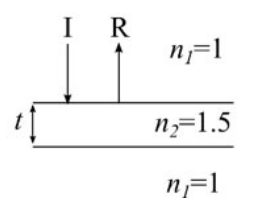
A slab of refractive index 1.5 and thickness t is surrounded by air on both sides. Light of free-space wavelength 600 nm is incident normally. Find the minimum nonzero t giving destructive interference in reflected light, in nm.
Reflection at the first air-to-slab surface introduces a π phase shift, while reflection at the slab-to-air surface does not. The propagation phase difference is $4\pi nt/\lambda$. Destructive reflected interference therefore occurs for $2nt=m\lambda$. Excluding zero thickness, take m = 1: $t=600/[2(1.5)]=200$ nm. The quarter-wave thickness instead gives constructive reflection for this low–high–low arrangement.
More Interferometry and fiber-optic sensing: Interferometers and their applications in metrology, basics of fibre optic sensing, near-infrared (NIR) sensing, UV-VIS spectrophotometers, mass spectrometer questions
GATE 2026 IN Q64– For a fiber Bragg grating-based sensor, the shift in the Bragg wavelength gives…
GATE 2025 IN Q55– The shown Michelson interferometer measures a gas refractive index. Its transparent…
GATE 2023 IN Q45– A silica-glass fibre has core index 1.47 and cladding index 1.44. The cladding is…
GATE 2022 IN Q39– A car moves collinearly with a transceiver’s laser beam. A pulse emitted at t=0 returns…
GATE 2021 IN Q32– A Michelson interferometer’s movable arm is displaced 325 μm in vacuum (n = 1), and 1000…
GATE 2021 IN Q65– A large multimode fibre has n core=1.5 and n clad=1.2. A section with cladding removed…