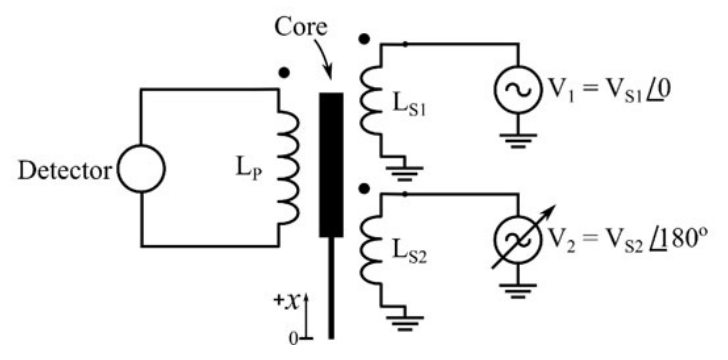
An LVDT has mutual inductances M₁,M₂ to its two secondary coils. Their self-inductances remain constant with displacement x. At x = 0, M₁ = M₂ = M₀. Over ±10 mm, M₁,M₂ change linearly and oppositely; each changes in magnitude by 0.25M₀ at either endpoint. The secondary excitation phasors are V₁ at 0° and V₂ at 180°. At x = D the detector voltage is zero when |V₂| = 1.25|V₁|. Find D in mm, to one decimal place.
For the symmetric LVDT shown, the opposing induced primary voltages null when $M_1|V_1|=M_2|V_2|$. Thus $M_1/M_2=1.25$. The linear changes give $M_1=M_0(1+0.025D)$ and $M_2=M_0(1-0.025D)$ with D in mm. Solve $1+0.025D=1.25(1-0.025D)$ to obtain $0.05625D=0.25$, so D = 4.444 mm, rounding to 4.4 mm.
More Displacement force and pressure measurement: Displacement, velocity, acceleration (linear and angular), force, torque, vibration, shock and pressure (low and high) transducers questions
GATE 2025 IN Q22– Match the sensors with their most suitable applications. Sensors: P. Rotary Variable…
GATE 2022 IN Q12– A pneumatic nozzle-flapper system is conventionally used to convert
GATE 2021 IN Q29– Given mercury density 13600 kg/m3, gravity 9.81 m/s2, and atmospheric pressure 101 kPa, a…