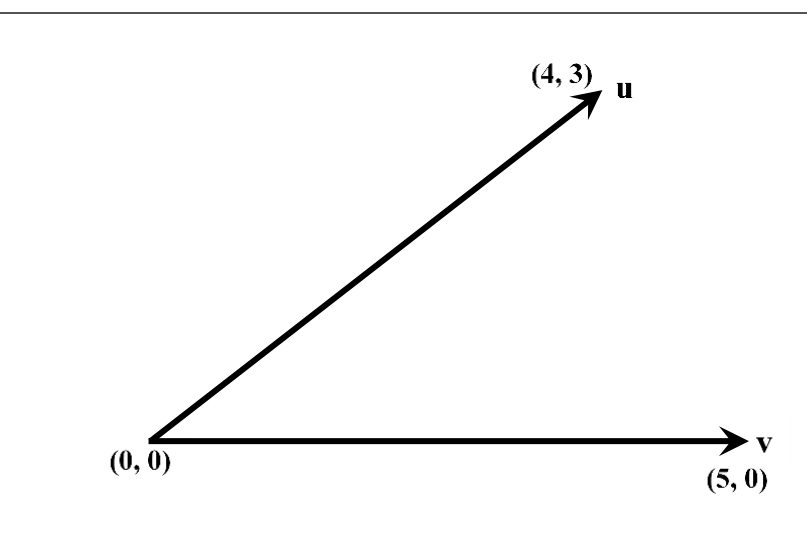
In the figure, the vectors $\mathbf u$ and $\mathbf v$ are related as: $\mathbf A\mathbf u=\mathbf v$ by a transformation matrix $\mathbf A$. The correct choice of $\mathbf A$ is
(In the figure, $\mathbf u$ goes from (0,0) to (4,3) and $\mathbf v$ from (0,0) to (5,0).)
Both vectors have length 5, so $\mathbf A$ is a rotation taking $(4,3)$ onto $(5,0)$, i.e. a clockwise rotation by $\theta$ with $\cos\theta=\frac45$, $\sin\theta=\frac35$: $\mathbf A=\begin{bmatrix}\cos\theta&\sin\theta\\-\sin\theta&\cos\theta\end{bmatrix}$. Check: $\left(\frac{16}5+\frac95,\ -\frac{12}5+\frac{12}5\right)=(5,0)$ ✓.
More Linear Algebra: Matrix Algebra questions
GATE 2022 EE Q20– Consider a 33 matrix A whose (i,j)-th element, a i,j=(i-j)3. Then the matrix A will be
GATE 2022 EE Q42– Consider a matrix A=bmatrix1&0&0\\0&4&-2\\0&1&1bmatrix. The matrix A satisfies the…
GATE 2020 EE Q52– The number of purely real elements in a lower triangular representation of the given 33…
GATE 2019 EE Q34– The rank of the matrix M=bmatrix0&1&1\\1&0&1\\1&1&0bmatrix is .
GATE 2019 EE Q36– Consider a 22 matrix M=[v 1\ \ v 2], where, v 1 and v 2 are the column vectors. Suppose…
GATE 2018 EE Q27– Consider a non-singular 22 square matrix A. If trace( A)=4 and trace( A2)=5, the…