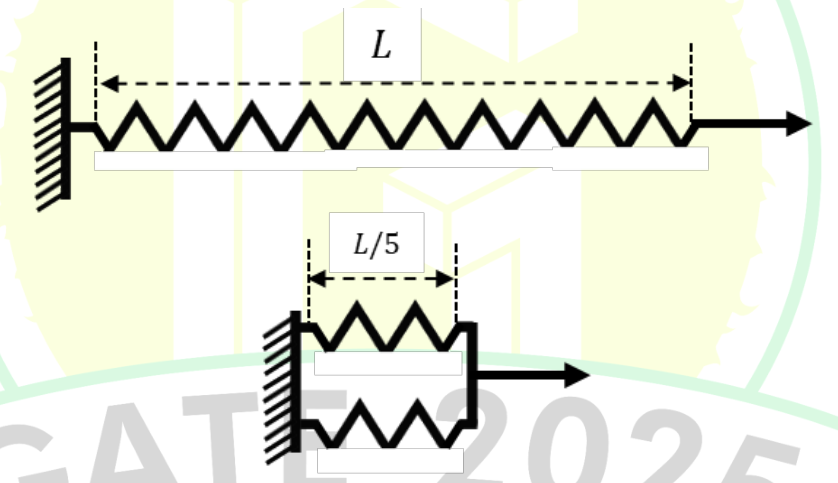
An ideal massless spring with stiffness 1 N/m is cut into five equal lengths. Two pieces are connected in parallel as shown. Find resultant stiffness, nearest integer N/m; assume linear behaviour.
For a uniform spring, stiffness is inversely proportional to length. Each one-fifth-length piece therefore has stiffness five times the original, or 5 N/m. Parallel springs experience equal displacement and add forces, so their stiffnesses add: 5+5=10 N/m.
More Soft Tissue Mechanics questions
GATE 2024 BM Q31– A cylindrical tissue has diameter 2 cm,height 3 cm,Young’s modulus 20 MPa. Under axial…
GATE 2023 BM Q24– Which dimensions represent dynamic viscosity, using M for mass, L for length and T for…
GATE 2023 BM Q31– A tissue has Young’s modulus 3.6 kPa and Poisson’s ratio 0.2. Find its shear modulus in…
GATE 2022 BM Q46– Which relation approximates arterial pulse-wave speed C in terms of inner diameter D, wall…
GATE 2021 BM Q25– Treat blood as red cells suspended in a Newtonian fluid. What is the intended effect of…
GATE 2021 BM Q57– A renal artery has lumen diameter 5 mm and mean blood speed 40 cm/s. Blood density is 1060…