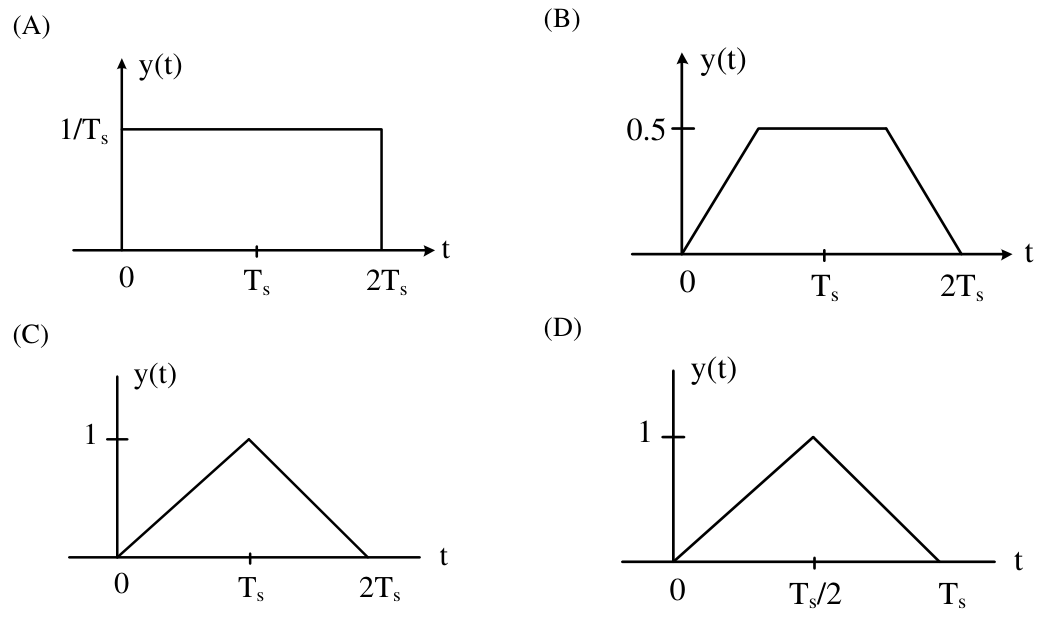
A binary baseband system transmits the pulse $$p(t)=\begin{cases}1/\sqrt{T_s},&0\le t\le T_s,\\0,&\text{otherwise}.\end{cases}$$ Which graphical choice shows its matched-filter output y(t)?
The matched filter impulse response is the time-reversed pulse $h(t)=p(T_s-t)$. Convolution of two equal rectangular pulses produces a triangle on 0≤t≤2Ts.
During the first interval its value is the overlap length t divided by Ts; after Ts it is (2Ts−t)/Ts. The peak at t=Ts equals the pulse energy, which is 1.
Thus the correct graph is **C**, with unit peak at Ts and zeros at 0 and 2Ts.
More Digital Communications questions
GATE 2016 EC (EC3) Q61– A memoryless binary symmetric channel has bit error probability 10-5. If 105 bits are…
GATE 2026 EC Q22– Consider a discrete memoryless source with an alphabet of four source symbols. s(t) is a…
GATE 2026 EC Q32– A wireless digital transmission scheme is using 16-QAM over an additive white Gaussian…
GATE 2026 EC Q44– A QPSK modulated signal from an additive white Gaussian noise (AWGN) channel is received…
GATE 2026 EC Q63– The average bit error rate at the input of a (7, 4, 1) Hamming decoder is 0.10. The…
GATE 2025 EC Q41– A source transmits symbol S that takes values uniformly at random from the set \-2,0,2\.…