GATE 2016 EE (EE2) – Question 38
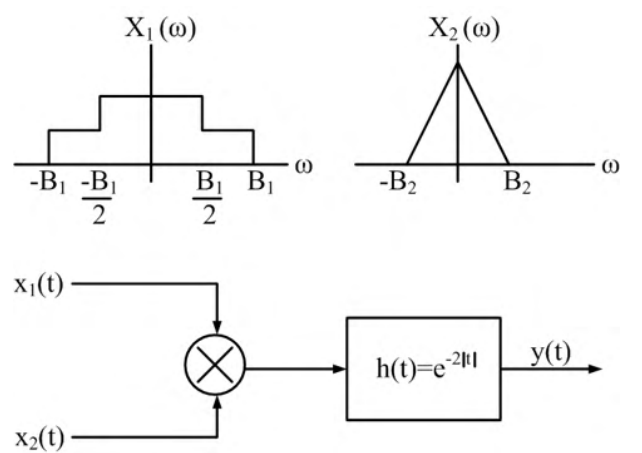
The spectra $X_1(\omega),X_2(\omega)$ have edge bandwidths B1,B2 as shown. The product $x_1(t)x_2(t)$ passes through a system with $h(t)=e^{-2|t|}$. The minimum sampling rate for unique reconstruction of y(t) is
Practise this question in The GATE Grind →
Show answer and explanation
Correct answer: (B) $2(B_1+B_2)$
Explanation
Multiplying the inputs convolves their spectra. Their supports therefore add, giving output half-bandwidth B1+B2. The filter has $H(\omega)=4/(4+\omega^2)$, which is nonzero at every finite frequency, so it does not narrow that support.
The Nyquist rate is twice the highest ordinary frequency, giving the official **2(B1+B2), B** under the bandwidth convention used by the choices.
The source axes are labelled ω. If B1 and B2 are read literally as angular frequencies in rad/s, the corresponding rate in samples/s is (B1+B2)/π. The original notation and keyed choice are retained with that units qualification.