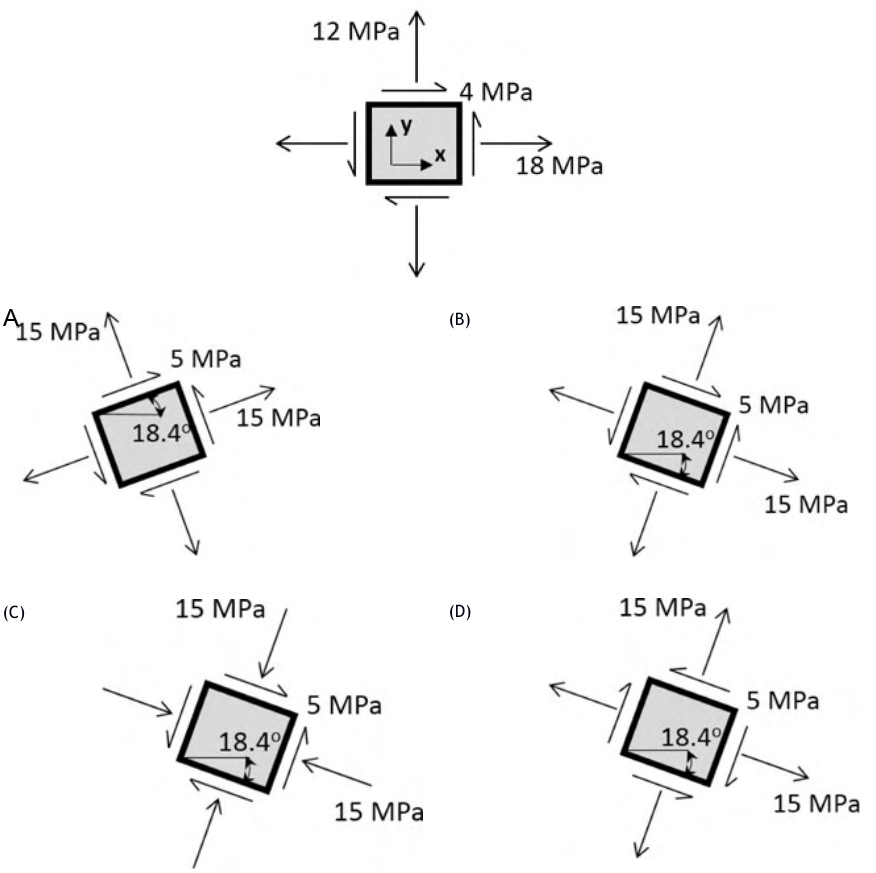
For the shown state σx = 18 MPa, σy = 12 MPa, τxy = +4 MPa, select the free-body diagram showing maximum in-plane shear and its associated normal stresses.
The mean normal stress is $(18+12)/2=15$ MPa. Mohr-circle radius is $\sqrt{[(18-12)/2]^2+4^2}=5$ MPa, so maximum in-plane shear magnitude is 5 MPa. For the relevant clockwise rotation, $\tan(2\theta_s)=-(18-12)/(2\times4)=-3/4$, giving θs = −18.4°. Applying the traction signs at this orientation gives B: outward 15 MPa normal tractions and the indicated 5 MPa shear sense.
More Strength of materials: Transformation of stress and strain, Mohr's circle, combined loading and failure criteria questions
GATE 2020 AE Q52– A solid circular ductile shaft with yield stress 280 MPa carries torque 10 kN m. Using…
GATE 2019 AE Q34– A plane-stress element has σxx=200 MPa, σyy=100 MPa and shear stress of magnitude 100 MPa…
GATE 2019 AE Q62– A bent circular bar has AB=0.55 m along x, BC=0.5 m along y and radius 0.01 m. An…
GATE 2024 AE Q46– The figure shows plots of two yield loci for an isotropic material, where I and II are the…
GATE 2024 AE Q52– The state of stress at a point is caused by two separate loading cases. One of them…
GATE 2025 AE Q59– A thin flat plate is subjected to the following stresses: xx = 160 MPa; yy = 40 MPa; xy =…