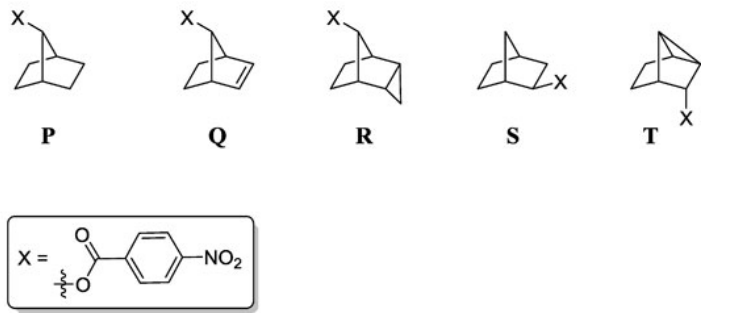
Solvolysis is accelerated when a suitably aligned neighbouring π or strained σ bond stabilizes the developing cation. T has the strongest favourable π participation; R benefits from cyclopropane σ participation; Q also has π assistance but a less favourable geometric relationship. S has less assistance, and P has the most difficult unassisted bridge-position ionization. Comparing those stabilization and alignment effects gives T > R > Q > S > P, A.
More Reaction Mechanisms: Basic mechanistic concepts and energy profile diagrams - kinetics versus thermodynamic control, Hammond’s postulate and Curtin-Hammett principle. Methods of determining reaction mechanisms through kinetics, identification of products, intermediates and isotopic labelling. Solvent effects in substitution and elimination reactions. Linear free-energy relationship – Hammett and Taft equations. questions
GATE 2019 CY Q19– What is the major product when the illustrated bridged allylic tosylate undergoes…
GATE 2025 CY Q52– Consider the following two reactions and their corresponding Hammett plots. Choose the…
GATE 2021 CY Q11– The rates of alkaline hydrolysis of the compounds shown below follow the order: