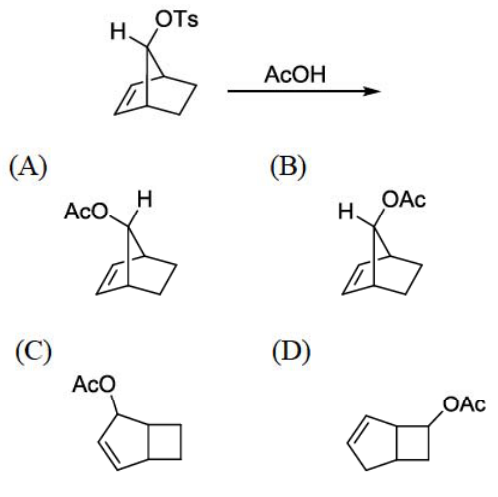
Departure of tosylate is assisted by the nearby π bond in the bridged system, stabilizing a delocalized cation and controlling which face acetate can capture. The net substitution retains the depicted bridge framework and produces the acetoxy orientation drawn in B. A reverses that stereochemistry; C and D change the carbon skeleton rather than giving the assisted substitution product.
More Reaction Mechanisms: Basic mechanistic concepts and energy profile diagrams - kinetics versus thermodynamic control, Hammond’s postulate and Curtin-Hammett principle. Methods of determining reaction mechanisms through kinetics, identification of products, intermediates and isotopic labelling. Solvent effects in substitution and elimination reactions. Linear free-energy relationship – Hammett and Taft equations. questions
GATE 2025 CY Q52– Consider the following two reactions and their corresponding Hammett plots. Choose the…
GATE 2021 CY Q11– The rates of alkaline hydrolysis of the compounds shown below follow the order:
GATE 2020 CY Q42– Rank solvolysis rates of compounds P,Q,R,S,T bearing leaving group X as drawn. X is the…