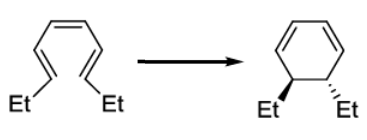
The conjugated triene supplies six π electrons, a 4n+2 electrocyclic system. Its thermal closure is disrotatory, whereas photochemical closure is conrotatory. Tracking the terminal ethyl groups to the shown trans product requires conrotation for this starting geometry. Therefore the allowed condition is photochemical conrotatory, D.
More Pericyclic Reactions and Photochemistry: Electrocyclic, cycloaddition and sigmatropic reactions. Diels-Alder reaction, Claisen and Cope rearrangements and their applications in organic synthesis. FMO method of analysis. Woodward-Hoffmann rules. Photochemistry of alkenes, arenes and carbonyl compounds. Photo-oxidation and photo-reduction. Di-π-methane rearrangements, Norrish type-I and II reactions. Paternό-Büchi reaction, Photo- Curtius and Wolff rearrangements. Barton and Hofmann-Lӧffler-Freytag reactions. questions
GATE 2019 CY Q23– On heating the illustrated cis-substituted 1,5-diene, which of the depicted…
GATE 2019 CY Q25– How many of the seven illustrated dienes undergo a Diels–Alder reaction with methyl…
GATE 2019 CY Q49– The illustrated unsaturated primary alcohol is treated with PCC and then ZnBr₂. Which…
GATE 2024 CY Q14– The major product in the following reaction sequence is
GATE 2024 CY Q54– Consider the following reaction sequence where M and N are the major products. The correct…
GATE 2025 CY Q27– Choose the correct option(s) with regard to mechanism of the following transformation.