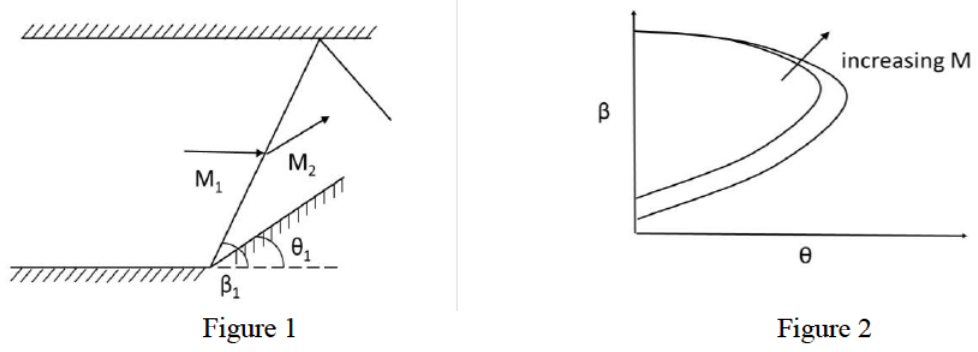
An incident weak oblique shock is reflected as a weak oblique shock from the wall, as shown. Which relation between shock angles β₁, β₂ and flow-deflection magnitudes θ₁, θ₂ is correct?
The reflected shock turns the flow back parallel to the wall, so θ₂=θ₁ in magnitude. The first shock reduces Mach number. On the weak-shock branch, producing the same turning angle at the lower incident Mach number requires a larger shock angle. Thus β₂>β₁, B.
More Compressible flows: isentropic flow, normal and oblique shocks, Prandtl-Meyer flow, nozzles and diffusers questions
GATE 2019 AE Q47– Across a stationary normal shock, p 2/p 1=1+[2/(+1)](M 12-1). Upstream air has speed 800…
GATE 2024 AE Q22– On Day 1, an aircraft flies with a speed of V 1 m/s at an altitude where the temperature…
GATE 2024 AE Q23– Consider a steady, isentropic, supersonic flow (Mach number M > 1) entering a…
GATE 2024 AE Q43– Shock structures for flow at three different Mach numbers over a given wedge are shown in…
GATE 2024 AE Q44– Air flowing at Mach number M = 2 from left to right accelerates to M = 3 across an…
GATE 2025 AE Q49– A supersonic stream of an ideal gas at Mach number M 1 = 5 is turned by a ramp, as shown…