GATE 2024 AE – Question 23
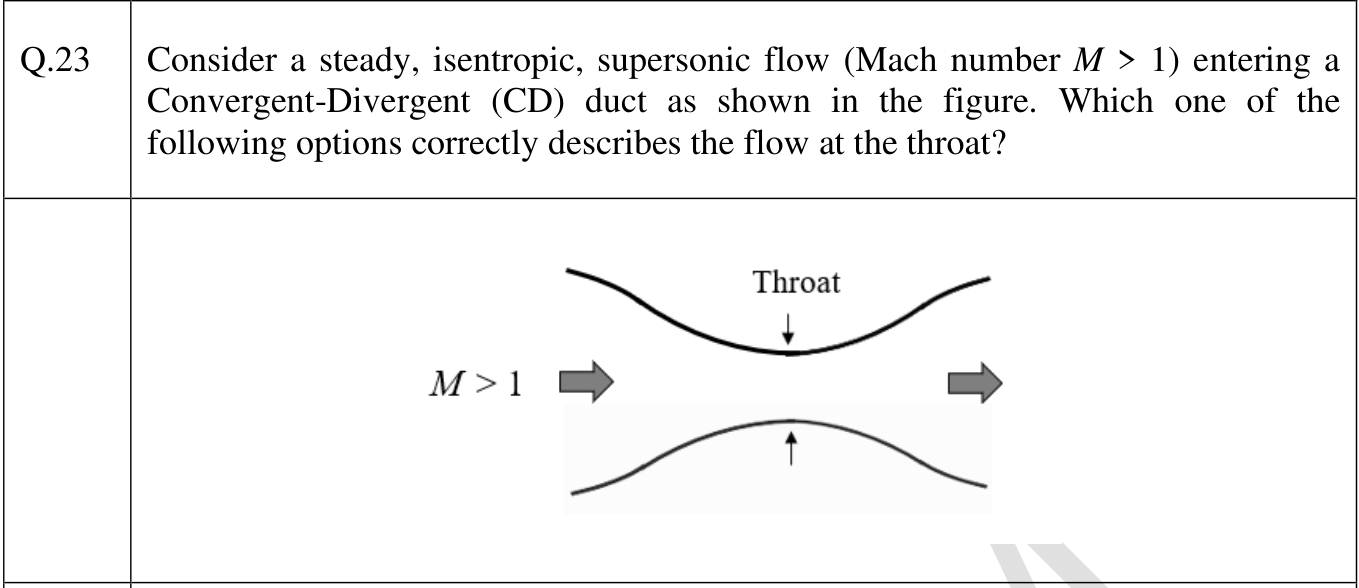
Consider a steady, isentropic, supersonic flow (Mach number $M > 1$) entering a Convergent-Divergent (CD) duct as shown in the figure. Which one of the following options correctly describes the flow at the throat?
Practise this question in The GATE Grind →
Show answer and explanation
Correct answer: (C) Can either be sonic or supersonic
Explanation
In the converging part the supersonic flow slows down as the area shrinks. In isentropic flow it cannot pass through $M = 1$ anywhere except at the minimum area. If the throat area equals the critical area the flow becomes sonic there, and if it is larger the flow is still supersonic. It can never be subsonic.