GATE 2024 AE – Question 24
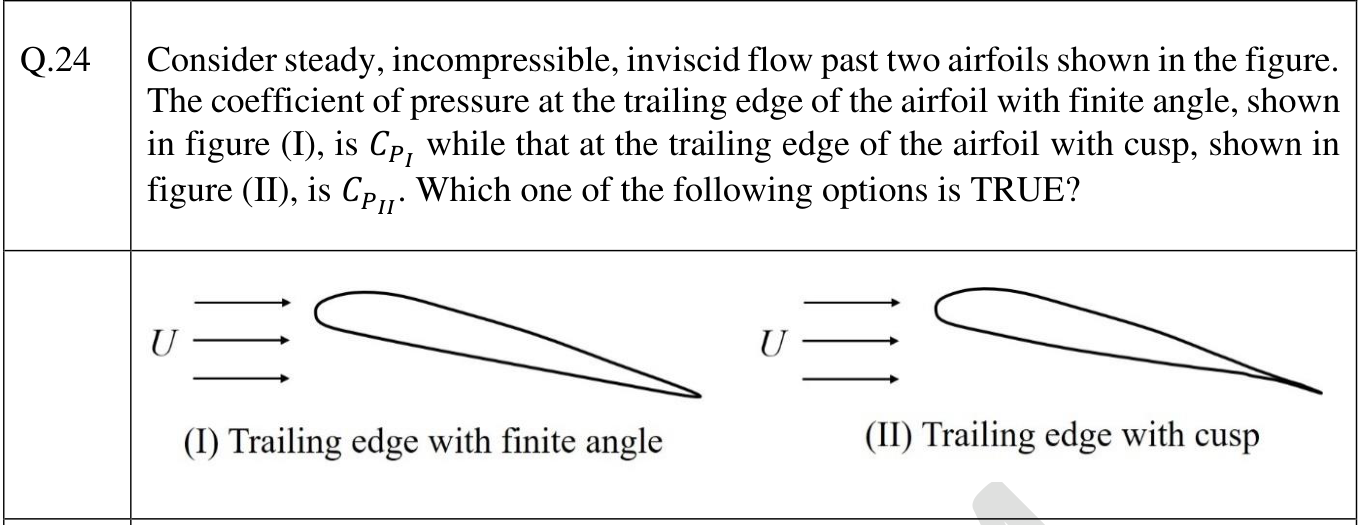
Consider steady, incompressible, inviscid flow past two airfoils shown in the figure. The coefficient of pressure at the trailing edge of the airfoil with finite angle, shown in figure (I), is $C_{P_I}$ while that at the trailing edge of the airfoil with cusp, shown in figure (II), is $C_{P_{II}}$. Which one of the following options is TRUE?
Practise this question in The GATE Grind →
Show answer and explanation
Correct answer: (C) $C_{P_I} = 1$, $C_{P_{II}} < 1$
Explanation
At a trailing edge with a finite angle the Kutta condition requires the velocity to be zero (a stagnation point), so $C_p = 1 - \left(\frac{V}{U}\right)^2 = 1$. At a cusped trailing edge the flow from the two surfaces leaves in the same direction with a finite and equal speed, so $C_p < 1$.