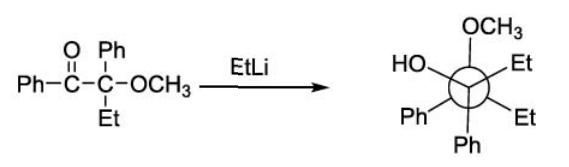
The carbonyl oxygen and neighbouring methoxy oxygen can coordinate the metal, constraining the substrate in a chelated conformation. Nucleophilic attack on its less hindered face gives the relative stereochemistry depicted in the product. This is Cram’s chelation model, B, rather than a nonchelation Felkin-type prediction.
More Organic Synthesis: Synthesis, reactions, mechanisms and selectivity involving the following classes of compounds – alkenes, alkynes, arenes, alcohols, phenols, aldehydes, ketones, carboxylic acids, esters, nitriles, halides, nitro compounds, amines and amides. Uses of Mg, Li, Cu, B, Zn, P, S, Sn and Si based reagents in organic synthesis. Carbon-carbon bond formation through coupling reactions – Heck, Suzuki, Stille, Sonogashira, Negishi, Kumada, Hiyama, Tsuji-Trost reactions; olefin metathesis, McMurry coupling and Buchwald-Hartwig amination reactions. Baylis-Hillman, Henry, Ritter, Sakurai, Tebbe olefination, Pauson-Khand and Nazarov cyclization reactions. Concepts of multistep synthesis – retrosynthetic analysis, strategic disconnections, synthons and synthetic equivalents. Atom economy and green chemistry, Umpolung reactivity – formyl and acyl anion equivalents. Selectivity in organic synthesis – chemo-, regio- and stereoselectivity. Protection and deprotection of functional groups. Concepts of asymmetric synthesis – resolution (including enzymatic), desymmetrization and use of chiral auxiliaries, organocatalysis. Carbon-carbon and carbonheteroatom bond forming reactions through enolates (including boron enolates), enamines and silyl enol ethers. Stereoselective addition to C=O groups (Cram, Prelog and Felkin-Anh models). Asymmetric aldol reactions – Evans reaction and proline catalyzed reaction. questions
GATE 2019 CY Q46– Two equivalents of ethyl acetoacetate react with formaldehyde using NaOEt in ethanol on…
GATE 2019 CY Q48– For the illustrated sequence, identify products P and Q: catalytic Pd(OAc)₂/PPh₃, Ag₂CO₃…
GATE 2019 CY Q51– Cyclohex-2-enone reacts with (CH₃)₂CuLi and then PhSeBr to give P, followed by H₂O₂ to…