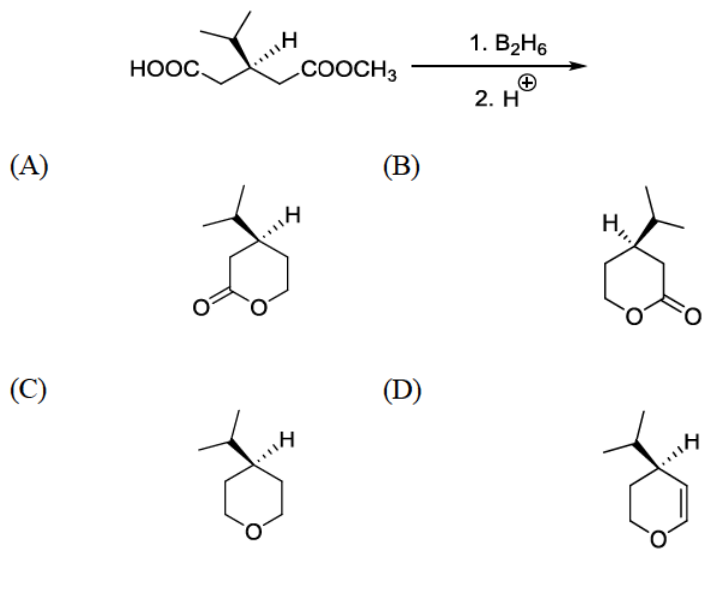
Borane preferentially reduces the free carboxylic acid to a primary alcohol, leaving the methyl ester available for cyclization. Acid workup enables intramolecular transesterification to a six-membered lactone. The original stereocentre is retained, and placing the carbonyl on the ester-derived side gives B. A interchanges which chain end was reduced; C and D remove the remaining ester carbonyl.
More Reduction: Catalytic homogeneous and heterogeneous hydrogenation. Metal based reductions using Li/Na in liquid ammonia, magnesium, zinc, titanium, and samarium. Hydride transfer reagents: NaBH4, L-selectride, K-selectride, Luche reduction, LiAlH4 and DIBAL-H. questions
GATE 2024 CY Q42– The major products X and Y in the following reaction sequence are
GATE 2026 CY Q14– The major product formed in the following reaction is
GATE 2023 CY Q11– The major product formed in the given reaction is
GATE 2023 CY Q48– Product(s) formed in the reaction below is(are)
GATE 2022 CY Q11– The major product M formed in the following reaction is
GATE 2021 CY Q16– The reagent(s) required for the conversion of hex-3-yne to (E)-hex-3-ene is/are: