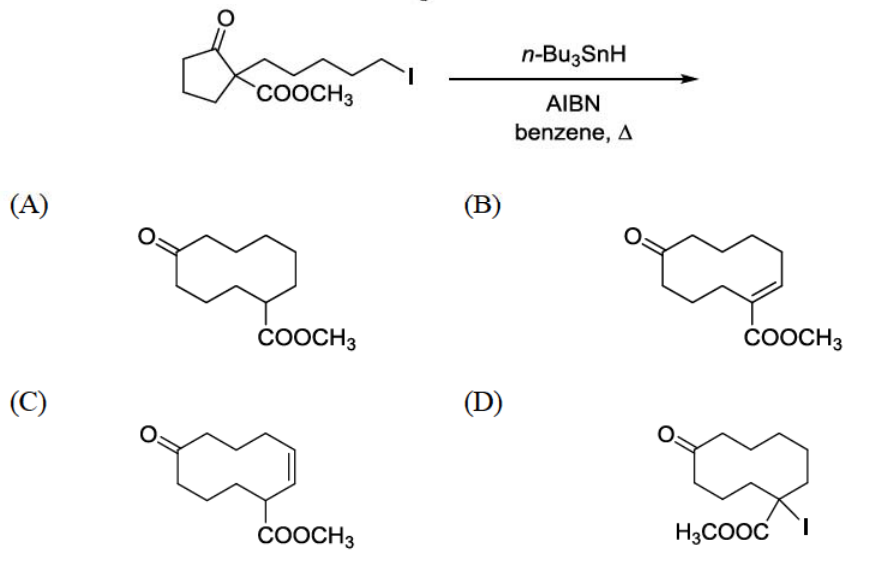
AIBN initiates a radical chain; tin radical abstracts iodine to generate the terminal carbon radical. Intramolecular attack on the ketone gives a cyclic alkoxy radical, which undergoes β-scission to expand the ring and restore a carbonyl. The resulting carbon radical abstracts hydrogen from tin hydride. This gives the saturated ring-expanded keto ester A. The unsaturated or iodine-retaining alternatives do not represent this radical ring-expansion sequence.
More Types of Reactions: Nucleophilic and electrophilic substitution reactions (both aromatic and aliphatic). Addition reactions to carbon-carbon and carbon-heteroatom (N and O) multiple bonds. Elimination reactions. Reactive intermediates – carbocation, carbanion, carbenes, nitrenes, arynes and free radicals. Molecular rearrangements. Barton decarboxylation and Barton-McCombie reaction, Hunsdiecker reaction. questions
GATE 2019 CY Q47– Cyclobutanecarbaldehyde reacts with CH₃MgCl and then HCl as illustrated. Which major…
GATE 2024 CY Q24– The reaction(s) that yield(s) X as the major product is (are)
GATE 2025 CY Q26– Among the given options, the possible product(s) that can be obtained from the following…
GATE 2025 CY Q54– The process(es) and/or intermediate(s) through which the following transformation proceeds…
GATE 2026 CY Q11– The major product formed in the following reaction is
GATE 2026 CY Q36– The major product formed in the following reaction is