The GATE Grind

GATE 2019 CY – Question 55

Inorganic Chemistry · Transition Metals: Coordination chemistry – structure and isomerism, theories of bonding (VBT, CFT, and MOT). Metal-metal multiple bonds. Energy level diagrams in various crystal fields, CFSE, applications of CFT, Jahn-Teller distortion. Electronic spectra of transition metal complexes: spectroscopic term symbols, selection rules, Orgel and Tanabe-Sugano diagrams, nephelauxetic effect and Racah parameter, charge-transfer spectra. Magnetic properties of transition metal complexes. Ray-Dutt and Bailar twists, Reaction mechanisms: kinetic and thermodynamic stability, associative, dissociative substitution and redox reactions. · 2 marks · Numerical answer

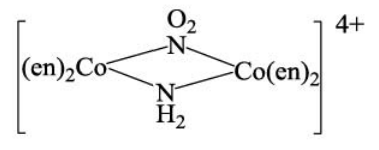
For the illustrated doubly bridged dicobalt ethylenediamine complex, how many optically active isomers are possible? en denotes ethylenediamine.

Diagram for GATE 2019 CY question 55

Practise this question in The GATE Grind →

Show answer and explanation

Correct answer: 2 to 2 OR 4 to 4

Explanation

Each cis-bis(ethylenediamine) cobalt centre can have Δ or Λ helicity. Combining the centres gives homochiral ΔΔ and ΛΛ forms, which are a mirror-image pair and optically active. Opposite-helicity combinations require attention to the bridge arrangement and symmetry; their treatment leads to the alternative count in the grading. The official answer explicitly accepts 2 OR 4, both retained as discrete alternatives rather than a continuous 2–4 interval.

More Transition Metals: Coordination chemistry – structure and isomerism, theories of bonding (VBT, CFT, and MOT). Metal-metal multiple bonds. Energy level diagrams in various crystal fields, CFSE, applications of CFT, Jahn-Teller distortion. Electronic spectra of transition metal complexes: spectroscopic term symbols, selection rules, Orgel and Tanabe-Sugano diagrams, nephelauxetic effect and Racah parameter, charge-transfer spectra. Magnetic properties of transition metal complexes. Ray-Dutt and Bailar twists, Reaction mechanisms: kinetic and thermodynamic stability, associative, dissociative substitution and redox reactions. questions
All Transition Metals: Coordination chemistry – structure and isomerism, theories of bonding (VBT, CFT, and MOT). Metal-metal multiple bonds. Energy level diagrams in various crystal fields, CFSE, applications of CFT, Jahn-Teller distortion. Electronic spectra of transition metal complexes: spectroscopic term symbols, selection rules, Orgel and Tanabe-Sugano diagrams, nephelauxetic effect and Racah parameter, charge-transfer spectra. Magnetic properties of transition metal complexes. Ray-Dutt and Bailar twists, Reaction mechanisms: kinetic and thermodynamic stability, associative, dissociative substitution and redox reactions. questions →