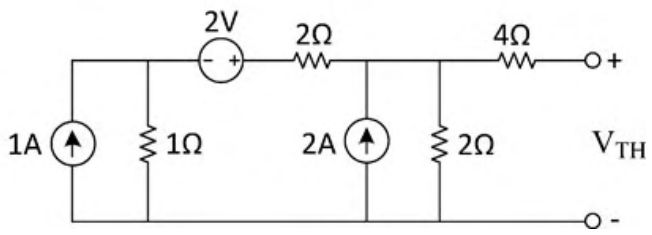
No current flows in the $4\ \Omega$ resistor (open terminals), so $V_{TH}$ is the voltage across the right-hand $2\ \Omega$ resistor, $V_B$. Let $I$ flow from node A to node B through the 2 V source and $2\ \Omega$. At A: $1=V_A+I$. At B: $I+2=\frac{V_B}{2}$. The branch gives $V_B=V_A+2-2I$. Solving, $I=-0.2$ A, $V_A=1.2$ V and $V_B=3.6$ V.
More Circuit Analysis questions
GATE 2018 EC Q63– Consider the network shown below with R 1=1\ , R 2=2\ and R 3=3\ . The network is…
GATE 2016 EC Q43– An AC voltage source V = 10(t) volts is applied to the following network. Assume that R 1…
GATE 2016 EC Q44– In the circuit shown in the figure, the maximum power (in watt) delivered to the resistor…
GATE 2015 EC Q17– In the network shown in the figure, all resistors are identical with R = 300\ . The…
GATE 2015 EC Q18– In the given circuit, the values of V 1 and V 2 respectively are
GATE 2014 EC (EC1) Q17– The figure is part of a larger electrical network. For R = 1 Ω, i₁ = 2 A, i₄ = −1 A and i₅…