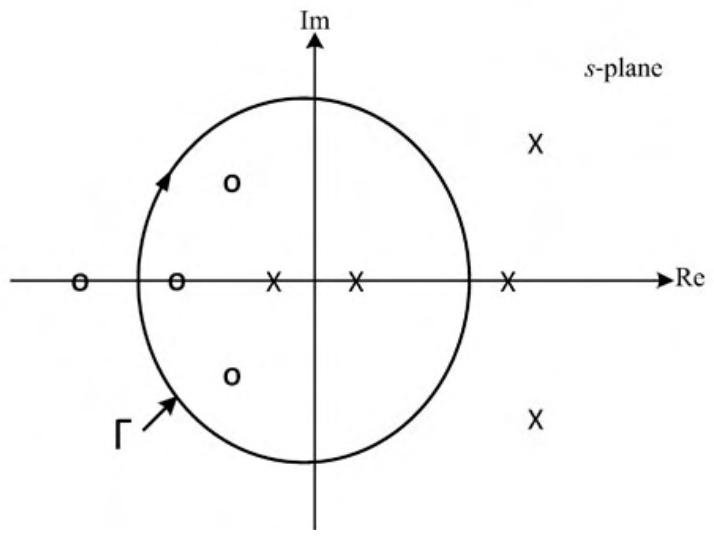
The pole-zero map of a rational function $G(s)$ is shown below. When the closed contour $\Gamma$ is mapped into the $G(s)$-plane, then the mapping encircles
the origin of the $G(s)$-plane once in the counter-clockwise direction.
the origin of the $G(s)$-plane once in the clockwise direction.
the point $-1+j0$ of the $G(s)$-plane once in the counter-clockwise direction.
the point $-1+j0$ of the $G(s)$-plane once in the clockwise direction.
Correct answer: (B) the origin of the $G(s)$-plane once in the clockwise direction.
Explanation
A contour traversed clockwise in the $s$-plane encircles the origin of the $G(s)$-plane $N=Z-P$ times in the clockwise direction, where $Z$ and $P$ are the numbers of zeros and poles of $G(s)$ inside the contour. The contour encloses three zeros and two poles, so $N=3-2=1$ clockwise encirclement of the origin. The point $-1+j0$ is relevant only for $1+G(s)$, not for $G(s)$ itself.
More Routh-Hurwitz and Nyquist Stability Criteria questions
GATE 2020 EC Q33– The loop transfer function of a negative feedback system is G(s)H(s)=K(s+11)s(s+2)(s+8).…
GATE 2018 EC Q15– The Nyquist stability criterion and the Routh criterion both are powerful analysis tools…
GATE 2018 EC Q52– The figure below shows the Bode magnitude and phase plots of a stable transfer function…
GATE 2016 EC Q29– Match the inferences X, Y, and Z, about a system, to the corresponding properties of the…
GATE 2016 EC Q30– A closed-loop control system is stable if the Nyquist plot of the corresponding open-loop…
GATE 2016 EC Q57– The transfer function of a linear time invariant system is given by H(s) = 2s4 - 5s3 + 5s…