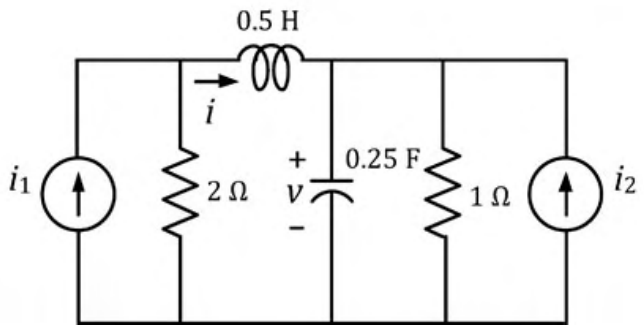
At the left node, $i_1=\frac{V_1}{2}+i$, so $V_1=2(i_1-i)$. The inductor gives $0.5\frac{di}{dt}=V_1-v=2i_1-2i-v$, i.e. $\frac{di}{dt}=-2v-4i+4i_1$. At the capacitor node, $i+i_2=0.25\frac{dv}{dt}+v$, i.e. $\frac{dv}{dt}=-4v+4i+4i_2$. These match option A.
More State Variable Model and Solution of State Equation questions
GATE 2019 EC Q43– Let the state-space representation of an LTI system be x(t)=Ax(t)+Bu(t), y(t)=Cx(t)+du(t)…
GATE 2018 EC Q39– The state equation and the output equation of a control system are given below:…
GATE 2014 EC (EC1) Q56– A state-space model is x=pmatrix-1&1&0\\0&-1&0\\0&0&-2pmatrixx+pmatrix0\\4\\0pmatrixu,…
GATE 2014 EC (EC2) Q56– An unforced LTI system obeys x=pmatrix-1&0\\0&-2pmatrixx. For x 1(0)=1, x 2(0)=-1, find…
GATE 2014 EC (EC2) Q58– For the state-space system represented by the signal-flow diagram, which property always…
GATE 2014 EC (EC3) Q57– An unforced system obeys x=A x. Initial state (1,-1)T gives x(t)=(e-t,-e-t)T; initial…