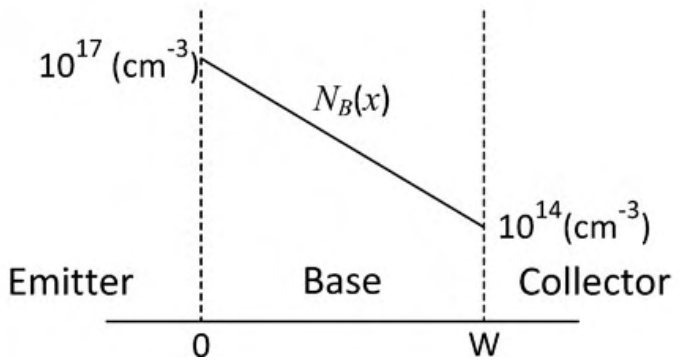
The base of an $npn$ BJT T1 has a linear doping profile $N_B(x)$ as shown below. The base of another $npn$ BJT T2 has a uniform doping $N_B$ of $10^{17}\ \text{cm}^{-3}$. All other parameters are identical for both the devices. Assuming that the hole density profile is the same as that of doping, the common-emitter current gain of T2 is
Correct answer: (D) approximately 0.7 times that of T1.
Explanation
The current gain of a BJT is inversely proportional to the base Gummel number $\int_0^WN_B(x)\,dx$. For the linear profile falling from $10^{17}$ to $10^{14}\ \text{cm}^{-3}$ this is about $0.5\times10^{17}W$, while the uniform base gives $10^{17}W$. So the gain of T2 is about half that of T1, and of the given options 0.7 is the nearest. The official key awarded this question to all candidates.
More P-N Junction and Semiconductor Devices questions
GATE 2020 EC Q44– A pn junction solar cell of area 1.0 cm2, illuminated uniformly with 100 mW cm-2, has the…
GATE 2019 EC Q20– The figure shows the high-frequency C-V curve of a MOS capacitor (at T = 300 K) with ms=0…
GATE 2019 EC Q45– The quantum efficiency () and responsivity (R) at a wavelength (in m) in a p-i-n…
GATE 2019 EC Q59– In an ideal pn junction with an ideality factor of 1 at T=300 K, the magnitude of the…
GATE 2018 EC Q17– In a p-n junction diode at equilibrium, which one of the following statements is NOT TRUE?
GATE 2018 EC Q28– A p-n step junction diode with a contact potential of 0.65 V has a depletion width of 1 m…