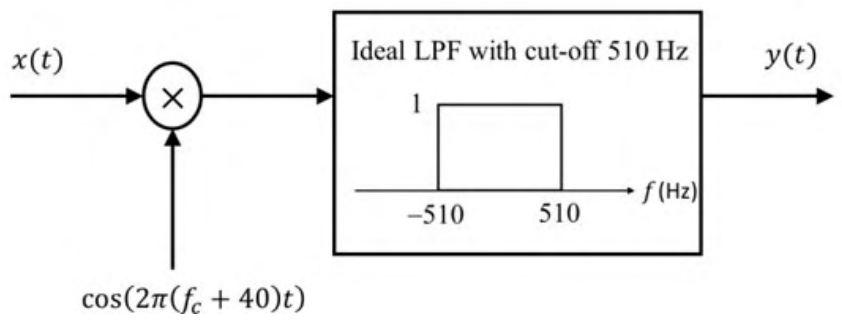
For the modulated signal $x(t)=m(t)\cos(2\pi f_ct)$, the message signal $m(t)=4\cos(1000\pi t)$ and the carrier frequency $f_c$ is 1 MHz. The signal $x(t)$ is passed through a demodulator, as shown in the figure below. The output $y(t)$ of the demodulator is
Multiplying by $\cos(2\pi(f_c+40)t)$ gives $4\cos(1000\pi t)\cdot\frac12\left[\cos(80\pi t)+\cos(2\pi(2f_c+40)t)\right]$. The low-pass filter keeps only the low-frequency part: $2\cos(1000\pi t)\cos(80\pi t)=\cos(1080\pi t)+\cos(920\pi t)$. These are at 540 Hz and 460 Hz, and the filter cut-off of 510 Hz passes only 460 Hz. So $y(t)=\cos(920\pi t)$.
More Analog Communications questions
GATE 2020 EC Q57– S PM(t) and S FM(t) as defined below, are the phase modulated and the frequency modulated…
GATE 2019 EC Q32– The baseband signal m(t) shown in the figure is phase-modulated to generate the PM signal…
GATE 2018 EC Q25– Consider the following amplitude modulated signal: s(t)=(2000 t)+4(2400 t)+(2800 t). The…
GATE 2018 EC Q37– Let c(t)=A c(2 f ct) and m(t)=(2 f mt). It is given that f c5f m. The signal c(t)+m(t) is…
GATE 2018 EC Q49– The input 4\,sinc(2t) is fed to a Hilbert transformer to obtain y(t), as shown in the…
GATE 2016 EC Q26– The block diagram of a frequency synthesizer consisting of a Phase Locked Loop (PLL) and a…